Open Infrastructures and the Future of Knowledge Production, part 2

In my last post, I unpacked some of the reasons why open infrastructures matter for the future of knowledge production, and I talked a bit about how Humanities Commons and hcommons.social strive to live out their principles of community governance that truly open infrastructure requires. But I ended on a less cheerleadery note: We aren’t a perfect alternative to the corporate platforms by which we’re surrounded. And this is where we need to dig down into the dirty underside of digital infrastructure. As Deb Chachra points out, the term “infrastructure” literally points to those systems that are hidden, in our walls, under our floors, and buried underground. If we are going to mitigate the inequities created by and sustained through our infrastructures, we have to get busy unearthing those systems and finding ways to build new ones. 

And so: We need to take a hard look at the fact that the infrastructure that Humanities Commons is built upon is AWS, or Amazon Web Services. As you might guess from the name, AWS is part of the Greater Jeff Bezos Empire, and every dollar that we spend to host with them helps to keep that empire running. And run it does! Amazon’s revenue derived from AWS passed $80 billion-with-a-b in 2022, and as of August 2023, AWS hosted 42 percent of the top 100,000 websites, and 25 percent of the top one million (ironically enough including BuiltWith, the site from which these data are made available).

Why has Amazon become such a powerful force in web hosting and cloud computing? Largely because they provide not just servers but a powerful and wide-ranging suite of tools that help folks like us not just make our platform available but also help keep it stable and secure and enable it to scale with enormous flexibility. AWS provides connected equipment and tools that would be more than a full-time job for someone to maintain in-house, and it enables redundancy and global reach at speed, and it’s relatively easy to manage.

So… it works for us, just as it works for 42,000 of the top 100,000 websites across the internet. But I’m not happy about it. It’s not just that I hate feeding more money into the Bezos empire every month, but that I know for certain that our values and Bezos’s do not align. And every so often I have to stop and ask myself how much good it does for us to build pathways of escape from the extractive clutches of Elsevier and Springer-Nature, only to have those pathways deliver us all into the gaping maw of Amazon?

AWS has a stranglehold on web-based platforms of our size, as we’re too complicated for a server kept under the desk, too big for a smaller hosting service, and too small for our own data center. And if you don’t want to deal with the risks and costs involved in owning and operating the metal yourself, there just aren’t many alternatives, and certainly not many good ones.

Our host institution, Michigan State University, like most institutions its size, operates both a large-scale data center through our central IT unit and a high-performance computing center under the aegis of the office of research and innovation. The latter can’t really help us, as it’s focused pretty exclusively on computational uses and not at all on service hosting. And the former comes with a suite of restrictions and regulations in terms of access and security – pretty understandably so, given recent attacks and exploits such as the one that caused our neighbor to the east to disconnect the entire campus from the internet on the first day of classes – but nevertheless restrictions that make it impossible for us to be flexible enough with our work.

In fact, central IT strongly encourages projects like ours to make use of cloud computing, given the complexity of our needs and the risk-averseness of the campus. And we have our pick! AWS, Microsoft’s Azure, and Google Cloud Services.

I just can’t help but think that it’s a Bad Thing for academic and nonprofit services like ours – services that are working to be open, and public, and values aligned with our communities – to be dependent upon Silicon Valley megacorps for our very presence. We need alternatives. Real alternatives. And I fear that we’re going to have to invent them, because as the example of open access publishing demonstrates, waiting to see what commercial providers come up with is certain to increase our lock-in, and increase the level of resources they extract from our campuses.

So what might it look like if our infrastructure for the future of knowledge production and dissemination was community-led all the way down? What might enable the Commons to leave AWS behind and instead contribute our resources to supporting a truly shared, openly governed, not-for-profit cloud service? Could such a service be collaborative, with all member research institutions and organizations paying into a shared, professionally staffed data center?

King’s College London and Jisc think so – they established the first collaborative research data center in the world nine years ago, precisely in order to help UK institutions achieve economies of scale, to increase energy efficiency, and to reduce costs. Of course, it’s a lot easier to get all the UK institutions of higher education on board with such a centralized initiative, partly because there are fewer of them and partly because they are all centrally funded.

But what if Internet2, for instance, instead of restricting its areas of interest to networking and protocols, and instead of offering to connect member institutions with corporate cloud services, instead provided a real alternative – one that was not just developed for the academic community but that would be governed by that community? What if each member institution or organization agreed to contribute its existing infrastructure, along with its annual maintenance budget, to a shared, distributed, community-owned cloud computing center? Could excess capacity then be offered at reasonable prices to other nonprofit institutions or organizations or projects like mine, in a way that might entice them away from the Silicon Valley megacorps? Would our institutions, our libraries, our publishers, and our many other web-based projects find themselves with better control over their futures?

None of what I’m suggesting here would be easy, and a lot of the questions I’ve just asked fall – at least for the moment – into the realm of the pipe dream. But if we were to be willing to press forward with them, we might find ourselves in a world in which the scholarly communication infrastructures on which we build, develop, design, and publish our work can help us foster rather than hinder social and epistemic justice, can empower communities of practice by centering their needs and their work to meet them, and can enable trustworthy community governance and decision-making in support of truly open, public, shared infrastructures for the future of knowledge production.


Open Infrastructures and the Future of Knowledge Production, part 1

I’ve been thinking a good bit lately about the ways that the future of knowledge production depends upon the openness of the infrastructures that support our work. For a lot of people, the word “infrastructure” triggers a yawn reflex, and not without reason. As Deb Chachra points out in her brilliant new book, How Infrastructure Works, the best thing that infrastructure can do is remain invisible and just work. But as Chachra also argues, the shape of our entire culture is dependent on our infrastructure, and where inequities are part of those systems’ engineering, they constrain the ways that culture can evolve. Infrastructure matters enormously, and the scholarly communication infrastructures on which we build, develop, design, and publish our work have deep implications for our abilities to foster social and epistemic justice in our knowledge production and communication practices, to empower communities of practice and their concerns in the development and dissemination of knowledge, and to enable trustworthy governance and decision-making that is led by the communities that our publications and platforms are intended to serve. Our team is far from alone in thinking about these questions right now. We’re seeing the idea of “open infrastructure” pop up a lot lately, in no small part because folks are recognizing that a commitment to open, public infrastructures is necessary to ensure that scholarly communication can become actually equitable.

What do I mean by “actually equitable”? How might that sense of equity intersect with the aims of the open-access movement? Over the last twenty-plus years that movement has worked to transform scholarly communication, arguing in part that if our work could be read more openly by anyone, it might both have more impact on the world at large and create a more equitable knowledge environment. It’s of course true that open access in its many present flavors has done a lot to make more research available to be read online. But the movement toward open access began as a means of attempting to break the stranglehold that a few extractive corporate publishers have established over the research and publishing process – and in that, it hasn’t succeeded. The last decade in particular has revealed all of the resilience with which capital responds to challenges, as those corporate publishers have in fact become more profitable than ever. Not only have they figured out how to exploit article processing charges in order to make some work published in their journals openly available while continuing to charge libraries for subscriptions to the journals as a whole, but they’ve also developed whole new business plans like the so-called “read and publish” agreements that keep many institutions tied to them, and they’ve developed new platforms and infrastructures like discovery engines and research information management systems that serve to increase corporate lock-in over the work produced on campus.

For all these reasons, the 20th anniversary statement of the Budapest Open Access Initiative took on a slightly different focus, noting that “OA is not an end in itself, but a means to other ends, above all, to the equity, quality, usability, and sustainability of research.” In order to achieve those ends, the statement proposes several key recommendations – and chief among them?

Host OA research on open infrastructure. Host and publish OA texts, data, metadata, code, and other digital research outputs on open, community-controlled infrastructure. Use infrastructure that minimizes the risk of future access restrictions or control by commercial organizations. Where open infrastructure is not yet adequate for current needs, develop it further.

This recommendation recognizes that the control of the infrastructure by profit-seeking entities cements inequities – and this is true even where the large corporate publishers purport to create opportunities for the disadvantaged by offering fee waivers and discounts on their publishing charges. Those discounts only serve to normalize a culture in which it is considered correct for those who produce knowledge to pay corporations to host and circulate it.

What scholarly communication needs today, more than anything, is a broad-based sense of accountability to scholars and fields and institutions rather than shareholders. Hence the call in the 20th anniversary Budapest statement for hosting open access research on open infrastructure: infrastructure that is led by us, and accountable to us.

This is the fundamental orientation and driving purpose of Humanities Commons. Our goal is to provide a non-extractive, community-led and transparently governed alternative to commercial platforms. We also want to encourage our users to rethink the purposes and the dynamics of publishing altogether, in ways that might allow for the development of new, open, collective, equitable processes of creating and sharing knowledge that re-center agency over the ways that scholarly work develops and circulates with the scholars themselves. As a result, we have put in place a participatory governance structure that enables both individual users and our institutional sustaining members to have a voice in the project’s future, and we have developed network policies that emphasize inclusion and openness. We are committed to transparency in our finances, and most importantly to remaining not-for-profit in perpetuity.

We are also working to build and sustain the kinds of new platforms and services that will allow for rich conversations among members of our community and between that community and the rest of the world. A year ago, seeing the handwriting on the wall for the platform formerly known as Twitter (and frankly having suffered through quite a number of unhappy years there before the beginning of the end), we launched hcommons.social, a Hometown-flavored Mastodon instance, in the hopes of providing a collegial, community-oriented space for informal communication among scholars and practitioners everywhere. We currently have more than 2000 users on our instance who are connecting with users throughout the Fediverse, and we support those users through a strong moderation policy and code of conduct. We also work to ensure that new policies and processes are discussed with that community before they’re implemented.

This kind of openness matters enormously, not just to ensure that we’re living up to the values that we’ve established for our projects, but to ensure that there’s a worthwhile future for them. Cory Doctorow has written extensively of late about what he has famously called the “enshittification” of the internet, a process in which value is sucked out of the community and into the pockets of shareholders. Users are left with no control over the platform, or the content they’ve provided to it. And this, he notes in a post on the new corporate platforms seeking to replace Twitter, remains true even if their C-suite is populated by good actors, because they’re still walled gardens.

The problem with walled gardens is partly about their ownership, but largely about their governance. It’s not just that the owners of any particular proprietary network might turn out to be racist, fascist megalomaniacs – it’s that we have no control if and when they do. Choosing open platforms means that we as users have a say in the future of the plots of ground we choose to develop. This is especially true for the kind of work, like knowledge production, that is intended to have a public benefit. It’s incumbent on us to ensure that those gardens aren’t walled, that they don’t just have a gate that management may one day decide to unlock to let select folks in or out. Rather, our gardens must be open from the start, open to connect and cultivate in the ways that we as a community decide.

As Doctorow notes, Mastodon is far from perfect, and as much as I love our own instance, hcommons.social is far from perfect. But we’re doing our best to ensure that we’re running it in the open. And operating in the open, both for the Commons and for hcommons.social, means for us that we are accountable to our users and responsible for safeguarding the openness of their work. Together, those two ideals undergird our commitment to provide alternatives to the many platforms that purport to make scholarly work more accessible but in fact serve as mechanisms of corporate data capture, extracting value from creators and institutions for private rather than public gain.

But, as I note, we aren’t a perfect solution to the problems of corporate control in scholarly communication. More on why in my next post.

The Pets of the Commons

This holiday season we thought we’d showcase some of our part-time team members. As a distributed team spread across two continents and three countries we generally meet online. One of the best part of virtual meetings is having our furry teammates show up and hang out. We’d like to introduce you to a few of them.

Kathleen Fitzpatrick, Project Director

Millie perched on top of a chair, looking longingly at the camera. Probably wanting a treat.

This is Millie, my sister’s family’s dog. She is a super chunk and did an excellent job of keeping me from falling out of my reading chair.

Annabelle Miller, Graduate Assistant

Han (left) and Athena (right). Han is a seven-year-old Plott Hound/Black Mouth Cur, and Athena is a six-year-old Pitbull mix. They love each other.

Han and Athena laying on a sofa, leaning on one another. Cozy.

Bonnie Russell, Product Manager

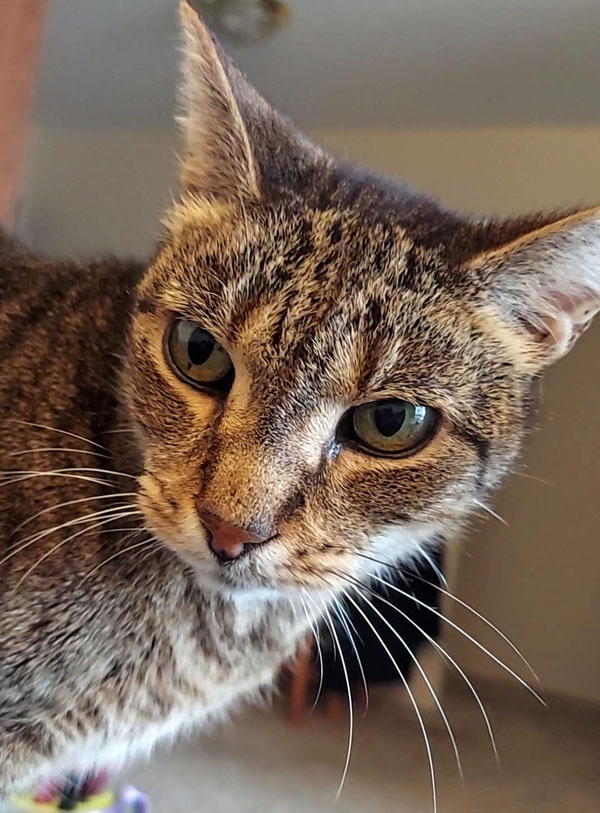
Mitro, a very cute cat, gazing thoughtfully into the camera.

Mitro (MEE-tro) is estimated to be about 12 and spent quite a bit of time outside before being rescued last year. His foster found him trying to find shelter during a thunderstorm and gave him the name Mitro as a play on the Assyrian word for rain, mitre. I adopted him in February and he’s a sweet and loving cat. If you have room in your home and heart consider an older cat. They have a lot of love to give.

Dimitri Tzouris, Infrastructure Developer

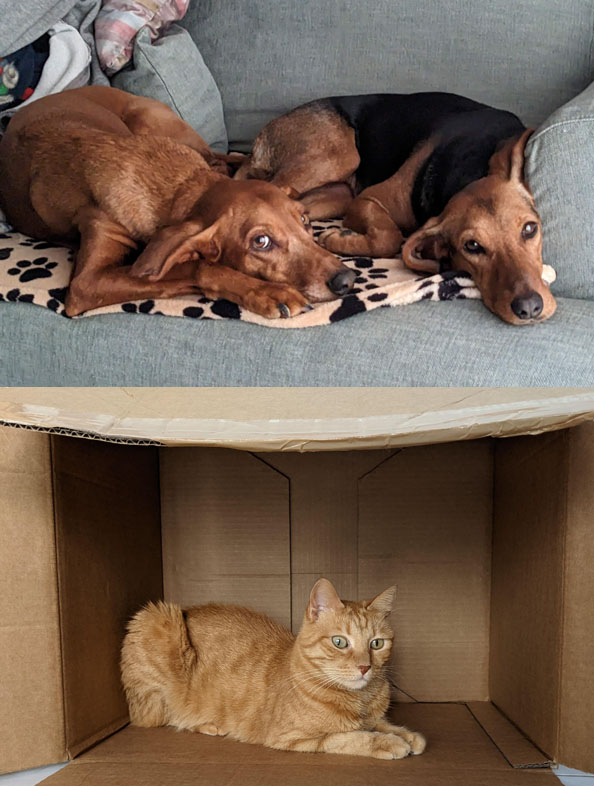
Mocha (left): Our first rescue dog. 7-yo female. Likes to cuddle and hates going out in the rain. Sleeps with us under the covers, no matter how heavy.

Zoe (right): Our second rescue dog. 3-yo and also a female. Still scared a lot when outside in an urban environment, but really enjoys running in the forest, during her daily walk with Mocha. She is full of energy and never says no to an extra treat.

Cookie: Our 9-yo female cat. Also a rescue. She likes company, but not too much. Looks puzzled when Zoe wants to play with her.

Mocha and Zoe, good girls who enjoy hanging out. Cookie, an orange cat, perched in a cardboard box.

Shel Vilag, Developer / User Experience Design

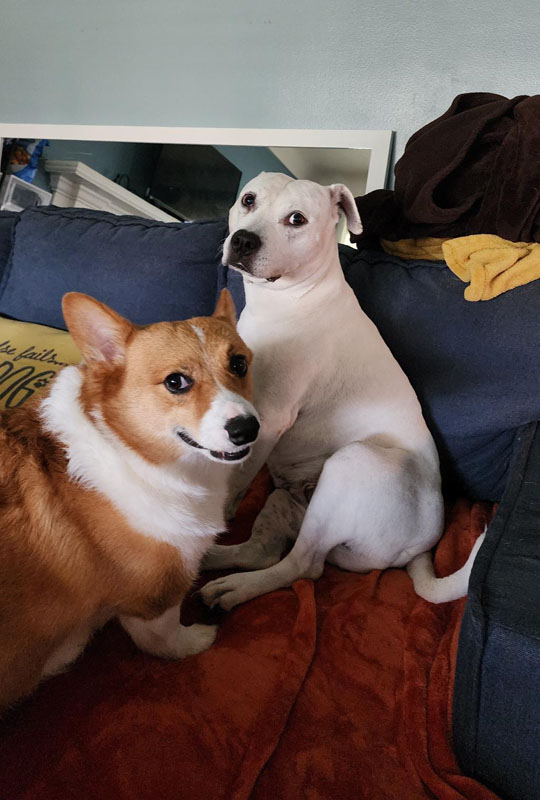
Torbjorn and Penny sitting on a sofa looking cozy.

Penny is a 10-year-old Pitbull who loves snuggles. Her special ability is being able to tell when food is done and letting her humans know. Torbjorn is a 4-year-old Corgi who is very good at playing fetch. He has very good hearing and loves to bark, especially at the furnace when it kicks on.

Zoe Wake Hyde, Community Development Manager

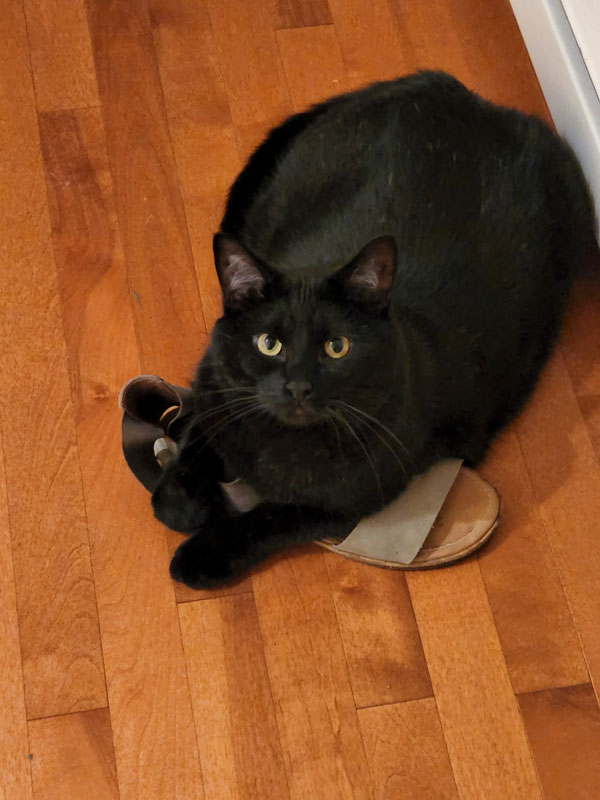
Meet Puck. He’s a sweet little rascal. Puck loves shoes, cuddling and assuming the loaf position in seemingly random spots around the house. The only human food he’s interested in is chips. He has been a constant companion throughout the early pandemic and several years of working from home, making his presence known in most video calls, demanding scritches. Zero notes. Perfect boy.

Puck, a big black cat laying on a shoe.

Larissa Babak, User Engagement Specialist

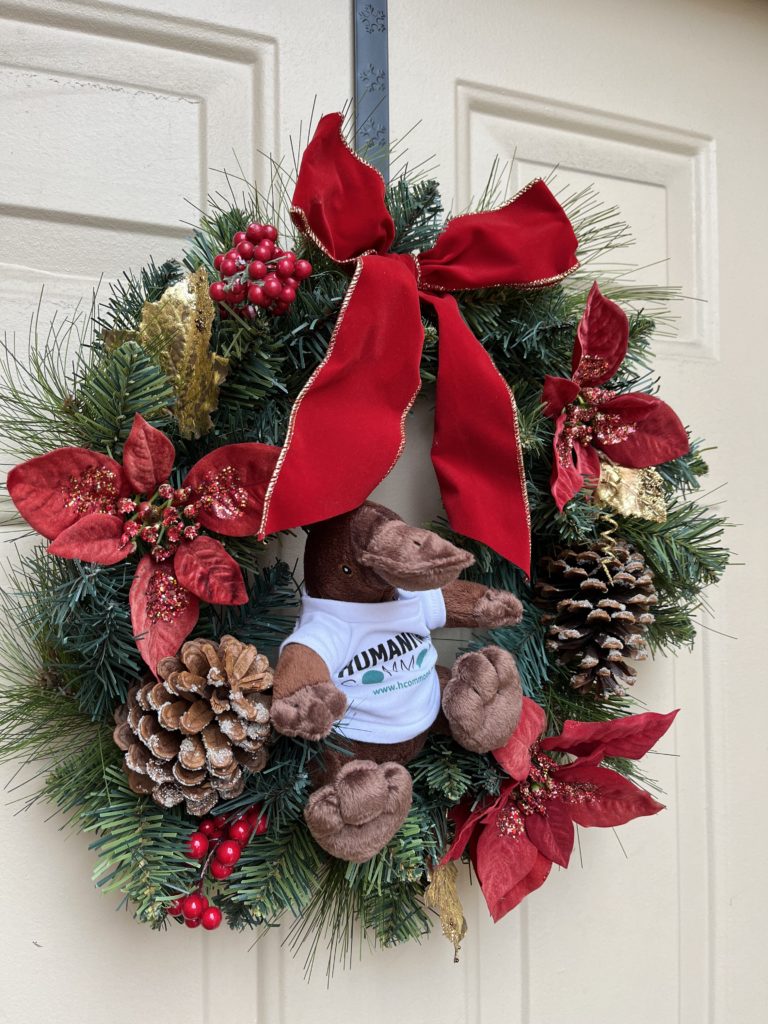
A Christmas wreath with a platypus stuffed animal perched amongst pine cones and poinsettia flowers.

The platypus is a native of Australia, but this platypus wandered all the way to the Detroit suburbs. Our team mascot has a penchant for anything that can be even vaguely categorized as “festive,” and despite the fact most platypuses build burrows near rivers, this one has created a much more merry home. In her spare time, she enjoys staying in touch with Millie, Han, Athena, Mitro, Mocha, Zoe, Cookie, Penny, Torbjorn, & Puck, as well as raising awareness for platypus conservation.

We’d love to see your furry team mates! Feel free to share them in the comments.

Reviewing, Editing, & Publishing: Open Access and the Public Philosophy Journal

As part of our celebrations building up to Open Access Week from October 23 – 29, we’re featuring a guest blog post authored by Shelby Brewster, the Associate Editor of the Public Philosophy Journal (PPJ). Humanities Commons and PPJ are MESH projects with generous support from Michigan State University’s College of Arts & Letters and MSU Libraries. If you’d like to learn more about PPJ, follow them on Facebook, Twitter, and Mastodon.

Like the Humanities Commons, the Public Philosophy Journal supports open access scholarly communications. The PPJ is an open access, digital-only journal that offers a forum for the curation and creation of accessible scholarship that deepens understanding of, deliberation about, and action concerning issues of public relevance. The theme of this year’s Open Access Week, “Community over Commercialization,” captures many of the ways that openness manifests in the PPJ. In contrast to many conventional publishing models, at the PPJ community is the foundation of our practices, from review to editing to publishing.

In Review: Community over Competition

At the PPJ, articles go through our Collaborative Community Review process (CCR). CCR sees the relationship between authors and reviewers as one of community rather than competition. In the collaborative review process, all parties come together as colleagues to enrich the work in question. Together with a Review Coordinator who facilitates the process, authors and reviewers engage in a constructive dialogue in which all parties are known to one another. The CCR process is completely open, recognizing that our positionality is part of our scholarship and encouraging a sense of thick collegiality for everyone involved. CCR does not serve a gatekeeping or purely evaluative function. Instead, review is rooted in mutual respect, a shared effort to advance scholarship to make a better world.

In Editing: Community over Elitism

Openness extends into our editorial policies and vision. As we explain on our website, “too often scholarly publishing engages in and reinforces exclusion rather than fostering the diversity of authors, readers, and issues in public and academic communities. Revising outdated ideas of who counts as a scholar and what counts as scholarship requires collective re-envisioning of how knowledge is developed, evaluated, and circulated through peer review and post-publication processes.” And so we maintain an open definition of expertise, recognizing that members of multiple communities that are not necessarily “academic” as such have perspectives and knowledge that benefit scholarship oriented toward the public good.

In Publishing: Community over Commercialization

All PPJ publications are open access, published in accessible formats, and available for reuse under the Creative Commons CC BY 4.0 license. We work to make our content easily accessible by communities both within and outside academia, and those that sit in between.

We also carefully consider which tools we use to create our work, as we acknowledge that these too should be aligned with our values. For publishing, we partner with Manifold, an open source publishing platform created by both publishers and scholars. Scholar-led infrastructure, like Manifold and the Humanities Commons, is an important way to value, support, and emphasize community in an ever-increasingly commercial publishing landscape.

To expand our commitment to community and support others who also wish to do so, the PPJ has been working on a new platform for values-based peer review, Pilcrow. In collaboration with Mesh Research and with the support of the Mellon Foundation, PPJ members and a development team have created an environment for a collegial review process that allows publishers and scholars to develop scholarship that aligns with their values, as well as openness and community. In the coming months, Pilcrow will be available, open source, for anyone looking to further integrate a commitment to community into their writing and publishing practice. So openness is an integral part of how the PPJ envisions community, in review, editing, publishing, and beyond. Community-led research infrastructure has the potential to not only give scholars more control over their data, but also support and facilitate innovative scholarship. Alongside our colleagues at the Commons and elsewhere, we’re committed creating community to support “scholarship as a series of collective acts toward advancing a just world.”

The Web We Want

As we seek new members to join our network, we want to share with you more of the inner workings of Humanities Commons and how we understand our work as part of a collective movement. Today, our community development manager, Zoe Wake Hyde, shares a vision of the future of the web that our team wants. If it resonates with you, we encourage you to consider becoming a Humanities Commons Member.

We live, as they say, in interesting times. The dawn of the internet is within living memory for many, and its different phases of growth and adoption are familiar to most. Whether you’ve gone from Tumblr to TikTok, reminisce fondly about RSS or are all in on AR, the only constant in our experiences of the web has been change.

In the scholarly world, the emergence of online publishing has led to exponential growth in the amount of content available. Traditional publishing systems have reacted by restricting access and trying to maintain scarcity, while the open access movement has gained momentum as a way of leveraging the web’s affordances to break down barriers to access. In turn, the major publishers have pivoted to data as currency, and there is increasing consolidation across the scholarly infrastructure landscape, leading to a concentration of power.

So what drives this change? The reasons are as complex and diverse as human behaviour itself, but two of the major contributing factors are money and power.

Where money is invested and power is leveraged has an enormous impact on our everyday lives on the internet. Unfortunately, much of that impact has been used to position us as consumers and commodities, to be bought and sold to, with our attention becoming the price of participation. That perhaps paints a grim picture, but it’s one we must confront head on.

Like the divine right of kings, so too can the power of the internet overlords be overthrown.

The good news is that money and power can be used to change things for the better. Investment in technologies that catalyze different kinds of interactions in digital spaces, and the right kind of influence on policy and structural mechanisms can make a difference.

So, why does this matter to Humanities Commons?

We see our role in the online ecosystem as creators of an alternative. We resist the idea that human interactions should be commoditized and used as a means to a profitable end. Instead, we seek to facilitate meaningful connections that lead to the creation of new knowledge to be shared openly. We approach designing our tools as an act of service, where our only interest is to benefit users. And we do this work in the domain of knowledge creation and dissemination because we believe in its value to the world.

We also see ourselves as just one piece of a very large puzzle of actors pursuing the same goal, and aim to ally ourselves with others dedicated to creating the same kind of future for online, digital scholarly work. Together, we seek a more just and equitable knowledge ecosystem, where many kinds of knowing are shared and valued. 

That’s the web we want.

But to get there, we have to come back to the question of money and power. To change the dominant logic of the web, we have to invest in the people and products that make it happen.

While we may not have venture capital-level funds available, our combined might as institutions, societies, nonprofits and other invested actors shouldn’t be underestimated.

In our next post, we will explore the role academic institutions have to play in this change.

Become a sustaining member of the Humanities Commons network and support us to build the web we want. Find more information or book a call via calendly.com/zwhmsu.

Purpose, Values, Process, Goals

As we seek new members to join our network, we want to share with you more of the inner workings of Humanities Commons and how we understand our work as part of a collective movement. Today, our founder, Kathleen Fitzpatrick, tells of how we have come together as a team, united by a shared purpose and shared values. If these resonate with you, we encourage you to consider becoming a Humanities Commons Member.

Since early 2020, Humanities Commons has been working toward a sustainable future. Key to that future is the generous support we’ve received from the National Endowment for the Humanities, the Mellon Foundation, and a range of other funders and donors, that has allowed us to build a flourishing team to support the network. But building that team has not been solely a matter of searches and onboarding; we’ve also put a lot of collective labor into ensuring that we’re working together in the most generative ways possible.

We began that work late last August by bringing our all-remote team (minus a few of our more recently hired colleagues) together in Lansing for a two-day retreat. Over the course of those two days, we began the process of getting to know one another, laying the groundwork for the ways we’d work together, and thinking as expansively as possible about our goals and expectations. We all left energized, if a bit daunted by how much work we had mapped out for ourselves and how vast the possibilities seemed. All of us took heart, though, in a sentence that Zoe Wake Hyde (our community development manager) shared with us: “We can’t do everything, but we can do anything!”

Figuring out which things would comprise our *anything* required a lot of collective thinking. During the retreat, we undertook a modified version of the HuMetricsHSS values framework exercise, starting to articulate what most matters to each of us in the work we do. We also began the process of developing a framework for the Commons’ purpose and goals, enabling us to shape our work around the vision of transformation in collective knowledge production that we hope to effect. 

But the retreat was only the start. Over the next several months, the team met for regular working sessions — twice a week, at first — to continue thinking together about who and how we wanted to be. Each of our working sessions was facilitated by a different member of the team, often using a Miro board to ensure that everyone’s thoughts were captured. By late 2022, we had collectively developed a statement of purpose and a statement of values for the network, which we circulated to our governing council and to our user advisory group for feedback.

Today, as part of our sustaining membership campaign, we’re posting these statements publicly, and we invite your thoughts about them. 

Our purpose is to cultivate open spaces for diverse communities to connect, create, share, and experiment. Together we work to transform global knowledge systems.

The values that guide our work are: Experimenting, Cultivating Community, Nurturing Trust, and Supporting Open Exchange of Knowledge

For a more in depth look, read our full statement of purpose and our full values statement, and we invite you to share feedback by commenting on this post or tagging @hello@hcommons.social on Mastodon.

These statements undergird our work as a team, but also our work with the Commons community. In the weeks ahead, as we bring more members into the community of organizations and institutions supporting our work, we’ll share more about how we plan to support that community, how we hope to facilitate self-governance within it, and more.

It’s been a long process leading to this point, but given that our goal is nothing short of transforming our global knowledge system, taking time for reflection, response, and revision is crucial. We very much look forward to hearing from you, and to thinking with you as we move into our next phase of development.

Celebrating Global Accessibility Awareness Day

Improving accessibility in all areas of our work is fundamental to our ambition to create more just and equitable scholarly communications.  In honor of Global Accessibility Awareness Day, we here at Humanities Commons wanted to let you know about some of the work we’re doing behind the scenes to both improve accessibility for site users and to learn and grow as a team. Here are four ways we are putting our commitment into action:

  1. Group Meetings On Topics Related to Accessibility: We’ve integrated accessibility-related topics into our regular working group meetings. This has included watching and reflecting on Axe-Con talks as a team and discussing how to bring inclusive design to all stages of our process.
  1. User Experience Design: From our website to our workshops to our pdfs, you’ll see some design choices and changes coming that aim to increase accessibility throughout the Humanities Commons experience. For example, we will be moving to Atkinson Hyperlegible as our default font. Created by the Braille Institute, this font is designed to increase character recognition and improve readability for visually impaired readers..
  2. User Experience Research: We’ve started whole team conversations about the process of user experience research and integrating a diverse range of voices and perspectives into our testing and conversations. We look forward to working with the community this summer and beyond to learn with and from you about your needs and experiences.
  1. Team Training: Over this coming summer, our team will be taking accessibility fundamentals from Deque University, as well as additional Deque University courses tailored to our daily tasks, and meeting in early Fall to work on integrating what we have learned into our workflows. 

We’re excited to share with you more in each of these areas as we continue to meet and grow as a team. And, of course, we’d love to hear from you if you have ways that you’d like to see our site improve!

Support Humanities Commons as a Sustaining Member

If you know Humanities Commons well, you know that we are committed to a more just and equitable future of knowledge creation. We take our place alongside other incredible people and organisations working towards the same goal, knowing the only way to make true, transformational change is to leverage our collective power.

Right now, we are seeking new members to join our network and help shape the future of the Commons. Our members are critical to our success and keep us connected with the needs and priorities of our community. By becoming a member, you are not only supporting our existing work, but creating new possibilities by contributing your unique perspective.

Hang on, I have an account already – doesn’t that make me a member?

Yes! But also no! Individual users of the Commons are members of our community, but more often, we’ll refer to you as our users. In this context, we are talking about members of our network of participating organisations.

So, why should I become a member?

Humanities Commons’ purpose is to cultivate open spaces for diverse communities to connect, create, share, and experiment, in the service of transforming global knowledge systems together. If this ambition speaks to you, membership is a way to help us work towards that purpose. Member contributions enable us to build the necessary infrastructure for a vibrant knowledge commons, developing exciting new features for individual and organisational users. Member support also helps us to continue to offer our free Humanities Commons site, which benefits everyone invested in open humanities scholarship. In future, we also plan for membership to subsidise the participation of organisations who serve communities most marginalised in conventional knowledge systems.

Just as importantly, membership is, to us, a relationship we seek to foster with our allies and collaborators. These relationships are what will ultimately drive us forward. We seek to be in relation with those who are investing in academy-owned infrastructure designed for a more connected knowledge ecosystem. Who are working towards a future where there are viable alternatives to the closed, proprietary systems that dominate, where we are building the web we want, and where people are treated as more than consumers and commodities. Truly, these relationships are an opportunity for us to lean into our collective power and imagination to build the future we envision.

Ok, but what does it mean to be a member? 

Membership in our network is not simply transactional. Members will be asked to, as much or as little as they can, participate in our evolving governance structures, offer feedback on strategy and direction, advocate for the Commons in the spaces they occupy, and participate in other efforts such as promotional activities and user research. Our goal is to create many avenues for members to contribute in the ways that make the most sense to them, and are always open to new ideas. As our network grows, we expect to develop additional opportunities, including research and funding collaborations.

In addition, all members receive:

  • Recognition as a sustaining member on our website and other communication channels as appropriate (e.g. conference presentations)
  • Quarterly member updates
  • Opportunities to promote and collaborate on projects with other members
  • The right to nominate & vote for governing council members
  • The ability to contribute to our roadmap (i.e. contribute to specific projects that are of importance to your organisation)
  • Top priority to join a cohort of institutions establishing their own Commons instances with our support (launching January 2024)

Interested? Here’s how to sign up.

Membership is open to any organisation, department, research center, institution, or consortium who wishes to engage with our work.

Until June 30, 2023, we are offering a one-time option for members to join at US$5000 per year, with the possibility of signing on at that rate for up to 5 years. However, if you are interested in becoming a member, but have a different budget in mind, please reach out, as we’d love to talk through different options.

The first step is to set up a call with our community development manager, Zoe Wake Hyde, at calendly.com/zwhmsu and she will guide you from there!

Find more information about membership and a short FAQ here.

Open Access for Teachers: A Reflection from a New Hire

Last week, we celebrated International Open Access Week with guest posts from some of our friends, and we decided to keep the party going a little longer! Today, June Oh, Assistant Professor in English & Digital Studies at The University of Texas at Tyler, shares her thoughts on the joy of an open access syllabus.


Recently, I realized something about open access. It’s not just about those publications I want to get; it’s about the support for the teachers. Previously, I shared my experience as an international student finding joy in open access (“Humanities Commons for International Students and Scholars”). Now adopting from an R1 university to an R2 mentality, and with a few access issues every now and then, what I experience daily isn’t just about research. It’s about teaching—and how open access is a shining light for a busy, worried, and eager instructor.

I’m a new hire with three new class preps and upcoming class pilot proposals for a new minor, a new certificate, and a new PhD program on my radar. As I was entering the job market as an English literature major—18C literature—I learned pretty quickly that all academic jobs, at least for the first several years, will ask me to teach outside my comfort zones and expertise. It does. And I need help.

From class activities and rubrics to syllabus and learning objectives, open access teaching materials available on Humanities Commons soothe my new hire anxiety. Googling works too, but sometimes the promising-looking syllabus sits behind the veil of the university proxy. Other times, I venture into platforms like “Teachers Pay Teachers” but rarely find higher ed materials. As of October 20, Humanities Commons hosts 402 items that are categorized as syllabus. Just looking at the topics and the titles of these courses inspire me. Also, what I love about Humanities Commons’ open access is that it opens space for what I consider teaching-in-progress. I search for “Digital Humanities syllabus,” and I see Kristen Mapes’ syllabi from 2017, 2018, and 2021, among others. What I see in these syllabi are Kristen’s continuing revisions and experiments with her pedagogy, materials, and approach. I know in theory no class is perfect and it’s a work in progress. But the academic plague of perfectionism gets in the way. That’s when actually having access to and reading the syllabi from other instructors through open access platforms is saving my day.

It’s starting to get chilly and the university bookstore is asking for a book request. And tonight, I’ll make some tea and find joy in open-access syllabi.

Finding Joy in Open Access: Reflections from the Humanities Commons Team

As we conclude our celebration of International Open Access Week, we asked our team to reflect on what joy in open access looks like for them.

Zoe Wake Hyde, Community Development Manager

As someone who has worked for many years in open access and open education, I have a somewhat complicated relationship to the theme we chose for this year’s OA Week. I have found genuine joy in doing work that I care deeply about, particularly in the relationships I have forged and the sense of belonging that the open community can inspire. But I’ve also experienced some pretty profound despair when things have gotten hard, progress has stalled, outside influences interfere (hello, pandemic) and our efforts have been co-opted by those who created the problems we’re trying to address in the first place. 

Joy is personal. Open work feels personal. It’s natural and, frankly, wonderful to find joy in this kind of work, but there is also always the risk of hurt that comes along with it. I don’t have any tidy solutions here, but there is a balance I am learning to manage between investing myself in my work and keeping enough distance that I can manage the tough times. I also think we should strive to learn from the incredible social justice movements that have come before us; nothing is ever entirely new and we would be wise to remember that we are far from the first to consider the personal costs of doing purpose-driven work.

What I am sure of is that whatever the risks of embracing joy, my work and my life are better for it. 

I can never resist a good book recommendation, so here goes: Joyful Militancy – Building Thriving Resistance in Toxic Times 

I also found this in the wilds of Twitter recently and felt it spoke to what I’ve written about here:

Bonnie Russell, Project Manager

As a librarian, I think a lot about how to ensure access to information of all kinds. Prior to joining the Humanities Commons team I spent almost 10 years in scholarly publishing, and I grew increasingly concerned about the sustainability of current publishing models. There is a growing barrier to access for many who are not affiliated with institutions or who are at institutions that simply can’t afford the increasing subscriptions in the current market. 

For me, the joy in OA is bringing information to everyone, regardless of position and financial means. OA allows everyone equal access to information, and at the same time it empowers everyone to disseminate their work widely. OA levels the playing field. It connects global collaborators, and it allows those who want to research and create to build on the work that has come before. 

Scholarship is becoming increasingly multimodal. Undergraduate students in the humanities are taught not just writing, but often work with audio, video, and video games. As these formats continue to grow journals and monographs won’t disappear, but they will come under increasing competition for views. OA offers these students and scholars the ability to share their work widely when many publishers simply can’t find a way to publish these new formats. My joy at this moment is being a part of the Commons and working to think about not just what’s happening now, but how we can support these new formats in the future.

Larissa Babak, User Engagement Specialist

When I think about finding joy in open access, my memory points me back to a collection of “aha!” moments.  

As part of my experience as an instructional designer, I’ve had numerous opportunities to talk to faculty about open educational resources. There are so many incredible OERs available, but often, faculty are not sure where to start when looking for an OER. Joy arrives in the “aha!” moments when a faculty member who is passionate about all the benefits of open access finds the right text for their course. 

As part of the Commons team, I constantly have my own, joy-filled “aha!” moments, too. Regularly, I’ll browse the CORE repository and spot a deposit with a fascinating title, or a colleague will share a deposit I might find of interest. In the user support I provide on the Commons, I’ve had the privilege to meet numerous journal editors who are moving their journals to the Commons in order to ensure their work is available to all. Each of these meetings are inspiring to me in the enthusiasm, dedication, and commitment brought to the cause of open access. 

In these ways, joy feels like the proverbial lightbulb going on inside my brain. Joy can be found in my personal moments of finding open access texts that inspire me, but also in the ability of open access to bring people together.