A Bumpy Start to the Joys of Open Access: A Festive Perspective

Today, as we continue to celebrate International Open Access Week and reflect on finding joy in OA work, we’ve got a guest post from our friends at H-Net and the Journal of Festive Studies.


More than six years ago, the open access joy of The Journal of Festive Studies began. Patrick Cox, the then-Vice-President for Networks at H-Net: Humanities and Social Sciences Online reached out to Ellen Litwicki and Aurélie Godet – both scholars of festive studies – to ask them to act as lead-editors for this new open access publication. H-Net had been established nearly 25 years before and had since blossomed into a well-established platform where scholars shared resources and ideas and published tens of thousands of freely available book reviews, making it well situated to publish an open access journal.

At the same time Patrick  reached out to Ellen and Aurélie, he also initiated the process of starting a new H-Net network, H-Celebration, to host the journal. Patrick also recruited me as managing editor and Réa de Matas, who currently is a member of H-Net’s Council, to become an editor for H-Celebration and develop the graphics and logos for the journal. In the background, Yelena Kalinsky, H-Net’s Associate Director of Research and Publications at the time, already worked their magic, supporting us as production manager—and with everything else. Basia Nowak and Charlotte Weber, the copyeditors for H-Net Reviews, soon joined the team with their copyediting expertise.

Back then, we received journal submissions via email, which we then had to upload and organize on a private H-Net network on the H-Net Commons. While this system worked well enough in the beginning, it quickly became confusing as we separated submissions, author bios, and peer reviews to ensure the double-blind peer review process. Luckily, Yelena was already working on another solution: using the Open Journal Systems.

Since the inaugural issue, a lot has changed. We now use Open Journal Systems – a management software for open access academic journals—a huge relief! A few months ago, Emily Joan Elliott took over for Yelena. After issue 4, Ellen will leave us and Isabel Machado, our guest editor for issue 3, has already begun to take over Ellen’s responsibilities, working with us on issue 5.

From the beginning, there was no question that the Journal of Festive Studies would be an online, open access publication that allowed authors to maintain the rights to their work through a Creative Commons license. We value that this approach would give everyone free access to research that isn’t hidden behind a paywall.

Together, the journal editors, the editorial board, and our contributors both find and bring joy by virtue of the field they study and knowing that others can freely access this scholarship. We are proud of the role we play in expanding the fields of both open access scholarship and festive studies. We hope others will join us in that work.

Cora Gaebel is the managing editor for the Journal of Festive Studies, a cultural anthropologist, a world traveler, and a life cycle celebrant.
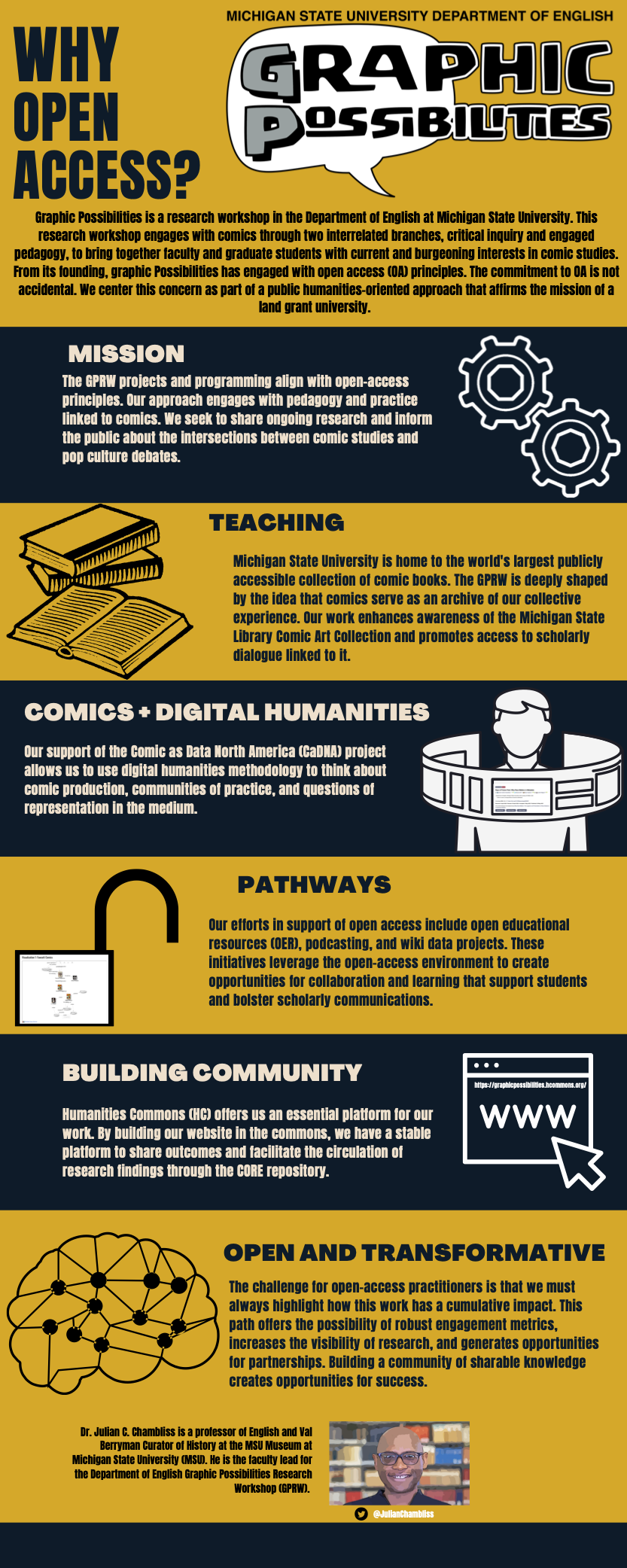
Why Open Access? An Infographic from Julian Chambliss

This week, October 24-30, is International Open Access Week and we’re celebrating by partnering with some of our friends to reflect on the theme of joy in open access!

In this infographic by Julian Chambliss—Professor of English at Michigan State University, Val Berryman Curator of History at the MSU Museum, and faculty lead for the Graphic Possibilities Research Group—shares his perspective on why open access matters.

An infographic titled "Why Open Access?" with information on the mission of the Graphic Possibilities project, connections with teaching, digital humanities,  and community building.
This infographic describes the impact of open access on Graphic Possibilities Research Group at Michigan State University. [Long description] [PDF version]

On Prior Publication

Last week, we received two takedown notices for items deposited to CORE. They arrived at nearly the same time, and so we found ourselves thinking about them in connected ways, though their cases are very, very different.

The first came through AWS Abuse, who passed on a report to us that we were distributing copyright infringing content. Under DMCA Safe Harbor provisions, we are required to take down such potentially infringing material immediately, and can only afterward follow up with an investigation to determine whether it’s actually infringing or whether it should be restored. Agreeing to follow this process is important to the network’s survival, as it’s only through such adherence that we can prevent the Commons from being sued for instances of copyright infringement of which we’re unaware.

In this case, we took the item down. Looking at the document revealed that it was a scan of copyrighted material, so the complainant may have a case. We have, however, inquired with the depositor in case there are complicating circumstances that we should know about.

The second request came to us from a user, who asked us to remove one of their deposits. Generally speaking, we resist removing deposits unless there are very good reasons, given our concern for the continuity of the scholarly record. In this case, it turned out that the deposit was a conference paper that the depositor later submitted for publication by a journal. The journal was now demanding that the deposit be removed, as they have a policy against accepting material that has been published elsewhere.

We reached out to the journal to ask about this policy, noting that even the venerable PMLA would not consider a conference paper deposited in a repository to be a violation of its prior-publication rule.

The response we received was — well, let’s say it — rude. The managing editor ultimately made it clear that if we did not remove the deposit, the journal would rescind its offer of publication to the author.

We are not in the business of harming the careers of our users, and so we have removed the deposit, if reluctantly. But we want to use this incident to open a conversation about the differences between conference papers and published articles, as well as between preprints and publications. We believe that authors have the right to share and seek feedback on the early stages of work prior to submitting that work to publishers, and that the existence of such pre-prints online does not constitute prior publication. And we urge our users to seek venues for publication that do not limit their rights over the ways they share their own work.

What issues have you run into in the relationship between sharing work online and publishing it in more formal venues? How would you encourage us to respond to situations like this? And how might we work together to create a more open, less extractive, and completely non-punitive scholarly communication ecosystem?

Embedded Documents in websites on the Commons

The Commons has long supported two plugins that allow users to embed PDFs and other documents within their Commons-hosted websites: PDFjs Viewer and the Google Docs Embedder. Both of these plugins are now obsolete and are being retired. We have converted embedded documents to download links.

There are cases where embedding documents may be useful, but embedding them into websites can have unintended consequences for users. Issues include:

  • Documents may not be accessible [for example, “An accessible PDF works with assistive technology software and devices, like screen magnifiers, screen readers, speech-recognition software, text-to-speech software, alternative input devices and refreshable Braille displays.” (CommonLook)]:
    • Images, graphs, and tables may not have alt-text to support visually impaired readers
    • Text size is not resizable and does not reflow as the page size changes
    • Screen magnifiers may not work on an embedded PDFs]
  • Users on mobile devices or tablets may be unable to read content as the document gets smaller on smaller devices
  • Embedded documents can be used by bad actors to spread malware, including ransomware

More on the issues with documents on websites can be found at the following sites:

In the interests of accessibility, readability, and security we’ve chosen to remove support for embedding documents in websites. We realize that they can be useful for sharing information such as forms and fliers for download. If possible, we suggest converting your documents to HTML and including a download link to the original. For more information on updating sites that have embedded documents, feel free to email us at hello[at]hcommons-staging.org and we can discuss strategies. 

Tiwari, Ashish. “Can Screen Readers Read Pdfs?” PDF Accessibility and Compliance, CommonLook, 18 Nov. 2020, https://commonlook.com/can-screen-readers-read-pdfs/.

Misinformation and the Commons

My birthday fell earlier this week, and brought with it the usual delightful overflow of Facebook greetings. It was always my favorite part of that platform, and it managed to draw me out of the semi-boycott I’ve been conducting to say thanks to everyone.

My semi-boycott means that while I haven’t deleted my account because I still lurk a bit in order to see pictures of my nieces and nephews and so forth, I don’t post or interact with others’ posts. This decision has largely been driven by the enormous damage the platform has wrought in recent years, at levels from national politics to individual health and well-being. I miss some of my interactions there, but the nausea I feel when I consider contributing my time and attention to that company is just too much to squelch.

I bring this up here because this morning we discovered a new CORE deposit filled with highly problematic claims about the spread of COVID-19 and the effects of vaccines. We don’t — and can’t — review deposits for soundness, and yet we bill ourselves as a scholarly network, where work with some measure of academic authority can be found. Because of this, I believe we have a responsibility to prevent, or at a bare minimum not contribute to, the spread of harmful misinformation.

As a result, we’ve removed the deposit, and we will remove any similar deposits that we uncover.

We want, however, to develop the best policies and processes we can in order to ensure our network — whose openness we are committed to — does not risk becoming another vector for damaging misinformation. We’d very much appreciate your thoughts about this work; please leave your ideas and concerns in the comments. We’ll keep you posted as our work continues.

We Need Your Input

The questions that have recently surfaced for us around community, safety, and trust have made clear the extent to which we on the Commons team need ongoing feedback and advice from our users. Our network governance model, recognizing that need, provide for two advisory groups: a technical advisory group and a user advisory group. Members of each are to be named by the Participating Organization Council, and each group will bring the concerns and ideas of the Commons community to the team for discussion and integration into our project roadmap. (See our bylaws for more details.)

We are currently seeking nominations for each of these groups. If you would like to join us, please email a brief statement of interest, along with a link to your Commons profile, to hello@hcommons-staging.org.

Let us know if you have any questions — we’ll look forward to hearing from you.

Community, Safety, and Trust

Earlier this month, the Modern Language Association held its annual convention, and our team hoped that we would be able to engage with attendees, helping them continue their conversations with one another via the Commons. Instead, we found ourselves fending off what initially looked like a bot attack: a massive influx of new account creation attempts with a few shared characteristics that made clear that there was orchestration involved. We put some measures in place to attempt to ensure that the majority of these attempts did not succeed, and spent several days playing whack-a-mole with the few that did.

In the process, it gradually came to seem that we might not be dealing with bots, but with humans: bad actors who were trying to find ways into the Commons community. To what end, we weren’t sure. But given the visibility of the MLA Convention, we really, really did not want to find out.

Things have gotten a bit quieter since the convention ended, but the suspicious account creation attempts continue. And fighting off this attack has taken all of the time that might have gone into the work we’re trying to do to improve and advance the platform, and it’s left our very small team exhausted. So we’re discussing some longer-term options, options that raise a few key questions we’d like to open up for discussion with the Commons community.

The most important question is this:

How do we balance our commitment to ensuring that the Commons is open to anyone — regardless of credentials, memberships, employment status, language, geographical location, and so forth — with our commitment to ensuring that the members of our community are safe and free from harassment? We’ve all seen much too graphically of late the costs of a hands-off approach to open social networks, but even within a more local academic frame of reference, we’ve seen what can happen when virtual events get Zoom-bombed or otherwise disrupted. We absolutely do not want members of our community to be threatened in any way that unsettles their ability, not to mention their willingness, to engage in the shared collaborative work that they’re undertaking here. We’re grateful that the Commons has managed to avoid such incidents up until now, but we’ve achieved a size and a visibility that has led us to become a target. As a result, we need to take action to protect the network and its members.

Should we establish some kind of verification requirement before new accounts are permitted to use some of the network’s features? We imagine that we might restrict new, unverified user accounts in ways that prevent such accounts from sending direct messages to other community members, for instance, or from creating unwelcome groups and sites within the network. This might work something like the trust levels model that Discourse uses, relying on a demonstration of good-faith engagement to gradually open up features to new accounts, though we may need something a bit lighter weight as we get started.

If we establish such a requirement, what paths toward verification should we enable? We could imagine verification happening as part of account creation if the new user uses an email address that demonstrates a connection with a trusted institution or organization, or if the new user links their account to another trustworthy scholarly data system such as ORCiD. But we also want to ensure that independent scholars and practitioners who may not have institutional credentials or established publication records can join us as well. Should we take the arXiv approach of having established members of the community vouch for new members, or does that run the risk of clubbiness? How do we preserve access for good actors while minimizing the damage that bad actors can do?

We welcome your thoughts on these questions, and we look forward to discussing the path ahead with the community as a whole.

Using the Commons for Canceled or Virtual Events

For those who have had to cancel events or shift to virtual meetings in response to COVID-19, this post will provide information about ways Humanities Commons could be a resource.

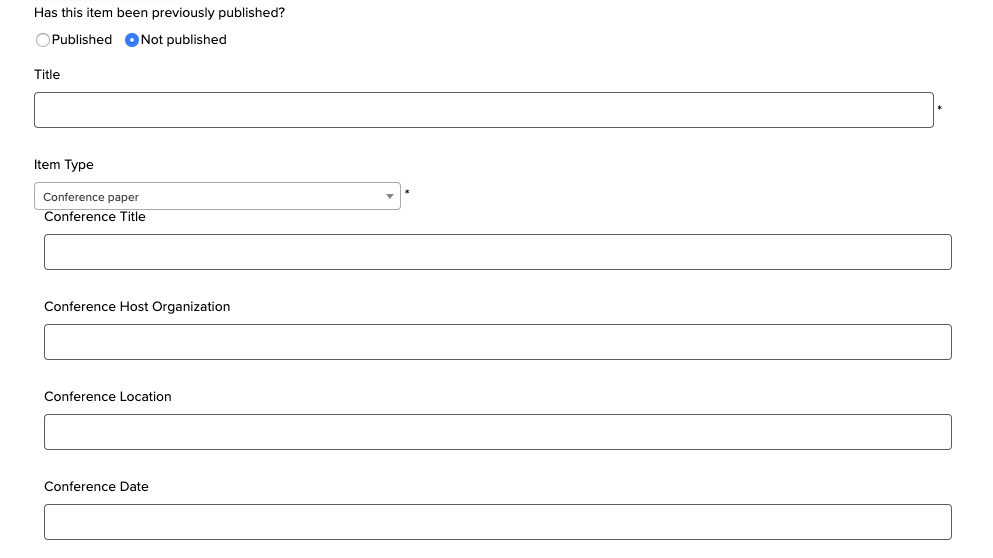
CORE, our open access repository, is a place presenters can share conference papers and other presentation materials. The deposit will get a DOI and structured metadata; it will be openly available and indexed. 

screenshot of core deposit page for a conference paper, which asks for conference title, dates, organizer.
The CORE deposit page for a conference paper.

Conference organizers can create a group for the event. Members of the group can use the discussion forum, calendar, documents library, and collection of CORE materials for asynchronous communication. For presenters who don’t want to share work in CORE (where work can’t be edited), Docs could be used instead of CORE. 

If the event doesn’t already have a site, organizers can create a WordPress site on the Commons to share information about the event and present conference materials. For more information, see What is the difference between a group and a site? 

The planning committee of the Global Digital Humanities Symposium recently decided that their event would not be held as planned. Instead of meeting in person, presentations will take place via Zoom. Below, you’ll find a guide adapted directly from the materials they are distributing to symposium participants, describing how to use their Commons group and CORE to participate in the event. You may find this example helpful to think about how you might communicate with your conference participants about using Humanities Commons.

Thank you to June Oh and the Global DH Symposium organizers for making this example available!

Continue reading “Using the Commons for Canceled or Virtual Events”

HC User Spotlight: Luís Henriques

Balloons

Luís Henriques is a musicologist and PhD candidate at the University of Évora. In this special birthday-edition HC User Spotlight, he reflects on how he has used CORE (over 250 deposits!) and sites hosted on the Commons to share his work.

I joined the Humanities Commons community in early 2017. The platform had launched in late 2016, so it was still in a very initial stage with not many users. I remember that at the time I was disappointed with surge of commercial advertisement and the introduction of a “premium” feature in academia.edu, where I had all of my research output. After reading an article posted by a senior scholar and user of that website where he raised some interesting questions for reflection, I started looking for a non-commercial platform. I found a 3-minute video of Nicky Agate at OpenCon 2016 on the The Right to Research Coalition YouTube channel. This led me to search for HC and found the website. In short, this is the story of me finding the Humanities Commons website. Continue reading “HC User Spotlight: Luís Henriques”

The Educator’s Guide to Humanities Commons

On Thursday, August 15th, we posted a Twitter thread through the @humcommons Twitter account that detailed the many Humanities Commons tools that educators might find helpful. Since this thread received such a positive response, we decided to also share it as a blog post here for posterity and in case any non-Twitter users might be interested in what it has to offer.

Below is a list of four Humanities Commons tools and resources that educators may find helpful. Continue reading “The Educator’s Guide to Humanities Commons”