What is the world coming to? In general terms, things don’t look good. Pandemics, climate change, ongoing global conflicts, the state of higher education as a whole. It can be a worrying time.
The situation for humanities research doesn’t look much better, either. The open access movement is succeeding at scale in the sciences, where in the not-too-distant future all scientific research will be available for anyone to read at no charge. Progress in the humanities, meanwhile, has been slower. Indeed, we face a dangerous scenario where all scientific work may be available freely to read, while all work in the humanities remains behind paywalls or in unaffordable books.
Humanities Commons, which celebrates its fifth birthday this year, has long been a forward-looking platform seeking to connect scholars with one another while also advancing open dissemination of research in our disciplines. HC remains one of the brightest hopes for the humanities in our ongoing difficult times.
Humanities Commons is also important because it focuses on social interaction rather than just technical innovation. It is easy to concoct techno-solutionist resolutions to questions of research dissemination, but these rarely gain traction. HC, instead, spreads its efforts between a sound technical infrastructure – the CORE platform – and a commitment to social embeddedness, embodied in the networking elements of the platform. If for-profit sites such as Academia.edu indicated an interest from humanities scholars in online sharing of their work and digital networking, then Humanities Commons is, for me, the implementation of that principle in a way that is congruent with the ethics of our disciplinary space. Certainly, it is easy to overuse the rhetoric of ‘the Commons’ in the digital world, as Samuel A Moore has cautioned, but the goals of Humanities Commons seem to fit the bill.
The other important element of HC that bears scrutiny is the affiliation with learned societies. Many open access (OA) initiatives have run aground on the rocky shore of learned society finances. Indeed, it is one of the dirty secrets of academia that many intra-disciplinary activities are funded by selling journal subscriptions; a cross-subsidy from libraries to societies. Humanities Commons has sidestepped this problem by twofold partnering with societies but also by embracing green OA, which has been shown not to result in subscription cancellations. HC is a symbiotic friend of societies, helping them to showcase the work in their disciplines, rather than its mortal, de-funding OA enemy.
So despite my gloomy opening, things are looking up, at least in our own small corner of the world. Happy birthday, Humanities Commons, and thank you for the ongoing good that you are doing.
It’s been a bit of a whirlwind, having this 5th birthday celebration for the Commons come so soon on the heels of Thanksgiving and Giving Tuesday, but the coincidence of these events has had me thinking about the many many aspects of this project and its development for which I’m grateful, and the ways we’re hoping to mobilize our resources, and our community, to transform the development, sharing, and preservation of knowledge in and around the academy.
We’ll be sharing some of the numbers in other posts — the growth in our membership, the flourishing of our repository, and more — but I want to focus a bit on our path to sustainability. As we originally noted in our plan for Sustaining the Commons, we migrated the platform to Michigan State University in order to have a secure home base from which to begin a program of expansion that we believe will lead us to both technical and financial sustainability in the years ahead. That expansion is supported by an Infrastructure and Capacity Building Challenge Grant from the National Endowment for the Humanities, a program which has challenged us to raise $1.5 million in order to release $500,000 in federal matching funds. Thanks to a generous change capital grant from the Andrew W. Mellon Foundation, and a wide range of gifts from groups including the Samuel H. Kress Foundation, the Open Society Foundations, and Digital Scholar — not to mention, of course, community members like you — we are nearing our goal, with only a bit over $200,000 to go. The combined fund created by all of these gifts provides us with a five-year runway to establish the business model that will enable us to be fully sustainable.
We’ve begun that work by investing in our team. Earlier this year, we hired Mike Thicke as our full-time lead developer. Mike has been working hard on remediating some of the technical debt that accrued over the last few years. This work includes getting our underlying software updated and squashing up some long-standing bugs, but also updating our workflows to make them more sustainable. Our project manager, Bonnie Russell, has been a key collaborator in that process, as has our graduate assistant, Katie Knowles. Our work is backed by the rest of the team at MESH Research, including Brian Adams, Kelly Sattler, Scott Schopieray, and has been made possible in the first place by the fantastic team at the MLA, past and present, who got us to this point, including Eric Knappe, Anne Donlon, Nicky Agate, Katina Rogers, Nelson Alonso, and more.
Additionally, we’re in the process of bringing on board two more Commons team members who will help our community grow: a community development manager charged with bringing in the new organizations and institutions whose investments in the platform will be the basis for our future financial sustainability, and a user engagement specialist who will work to ensure that individual users are successful in their goals for using the platform. And we’re also searching for a couple of technical folks: an AWS-oriented systems architect and administrator, and (posting soon!) an identity management engineer.
This expanded team will allow us to do the thing that we’ve all been hoping for: to move beyond a non-stop round of Whack-a-Mole with the most immediate day-to-day issues, to instead focus on the platform’s future. That future includes significant expansion, as we not only bring on new partner organizations but also add hubs for the social sciences and STEM fields to the Commons constellation. It also includes creating new forms of interoperability with other key scholarly tools, allowing your Commons account to serve as a hub for a wide range of online collaboration and communication activities.
Beyond the financial and the technical, however, lies another category of sustainability, one that we believe makes the others possible: social sustainability. This form of sustainability arises from the commitment of a community not just to working together on a particular project, but to the idea of building the conditions for that togetherness in the first place. We’re working to enable this social sustainability by implementing a governance model that gives our partner organizations and institutions a voice in the platform’s development, and that draws on the insights and goals of our users in establishing that development path. To that end, our Participating Organization Council — the equivalent of a governing board for the project — has appointed members to two new groups: a Technical Advisory Group and a User Advisory Group. We’ll be meeting with those groups in January, and we’ll keep all of you posted on how you might connect with them to provide your input into the future of the Commons.
The updates originally scheduled for today will be rolled out on Monday, November 15th.
Starting at 9am EST on November 11th we’ll be updating the Commons to WordPress 5.8 along with updating a number of core themes and plugins. This might cause some instability, though the site will remain up for use. If you experience some odd behavior try again later in the day. Email us at hello[at]hcommons-staging.org if it does not resolve, or if you experience any errors after 2pm EST.
What’s new in WordPress 5.8?
WordPress 5.8 brings big updates to the way sites can be edited. This includes:
Template editing: You can now edit templates by page, similar to the way SiteOrigin and Elementor works. For those of you with existing sites, you’ll need to turn on this new functionality in settings. For new sites this will be turned on by default.
Blocks as widgets: You can add blocks in widget areas and view them in the live preview through the customizer.
Block patterns: If you search for blocks, WordPress will suggest existing patterns created for specific uses.
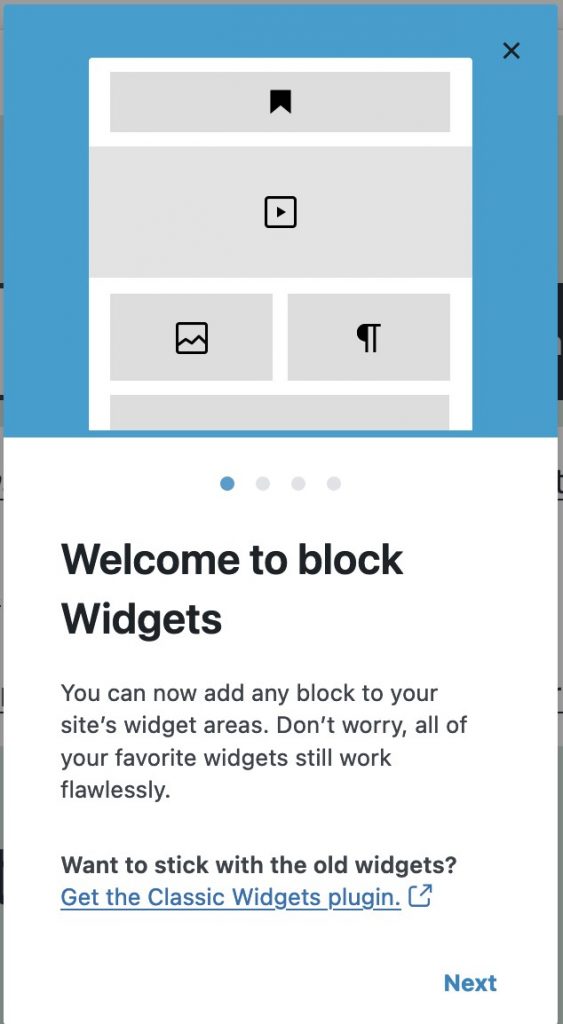
Site administrators, you may see a popup when you log into your site that looks like this:
The “Classic Widgets” plugin is not required, and we are not enabling it on the network. Your widgets should continue to work as expected after the update. If you do run into issues please email us at hello[at]hcommons-staging.org.
Theme and Plugin Updates
We’re also rolling out updates to themes and plugins. For those of you who use SimpleMag, there may be layout challenges. We’re doing our best to mitigate them, but if you do have questions please let us know. Other themes being updated include 15Zine and Eduma.
We are updating many plugins including: CommentPress, Elementor, NinjaForms, PressForward, and TimelineJS. If you use any of those plugins and experience issues please let us know.
As Humanities Commons’ fifth birthday approaches (more on that in a few weeks) we’re doing a bit of housekeeping to keep everything running smoothly. We’ll continue to communicate as we move forward, but wanted to let you know about two recent changes.
Website Cleanup
There are currently just over 1,500 websites on Humanities Commons. Among them are a few hundred that were created but never used. This includes both individual and group sites. We’ve gone through and found sites that have no posts or pages that are over one year old, and we’re contacting administrators to find out if they are still planning to use them. If not, we’ll delete them for you, and if you do we’re happy to point you to guides and other information on how to move forward. Any websites with content, new or several years old, will remain active on the platform. We don’t want to remove content, just clean up sites that may never be used. We’re planning on doing a site inventory once a year to keep the platform running smoothly.
Closing Comments on Posts after Two Weeks
We’ve noticed an uptick on spammers trying to exploit the comments on old posts to increase search engine rankings. These posts sometimes contain links to malware and other unwanted content. To continue to fight this spam we’ve automatically set post comments to close after two weeks. If you run a website on the Commons you can change this setting on your site by going to the admin panel and clicking on Settings/Discussion on the left-hand side. You’ll find the setting under “Other Comment Settings.”
If you have any questions or would like further information feel free to leave a comment here or email us at hello[at]hcommons-staging.org.
My birthday fell earlier this week, and brought with it the usual delightful overflow of Facebook greetings. It was always my favorite part of that platform, and it managed to draw me out of the semi-boycott I’ve been conducting to say thanks to everyone.
My semi-boycott means that while I haven’t deleted my account because I still lurk a bit in order to see pictures of my nieces and nephews and so forth, I don’t post or interact with others’ posts. This decision has largely been driven by the enormous damage the platform has wrought in recent years, at levels from national politics to individual health and well-being. I miss some of my interactions there, but the nausea I feel when I consider contributing my time and attention to that company is just too much to squelch.
I bring this up here because this morning we discovered a new CORE deposit filled with highly problematic claims about the spread of COVID-19 and the effects of vaccines. We don’t — and can’t — review deposits for soundness, and yet we bill ourselves as a scholarly network, where work with some measure of academic authority can be found. Because of this, I believe we have a responsibility to prevent, or at a bare minimum not contribute to, the spread of harmful misinformation.
As a result, we’ve removed the deposit, and we will remove any similar deposits that we uncover.
We want, however, to develop the best policies and processes we can in order to ensure our network — whose openness we are committed to — does not risk becoming another vector for damaging misinformation. We’d very much appreciate your thoughts about this work; please leave your ideas and concerns in the comments. We’ll keep you posted as our work continues.
Dr. Kendra Leonard, music scholar, librettist, and poet
Finding a Digital Home
“The span of what people can do [on the Commons] is really terrific,” Leonard remarked as we discussed the Commons. With a background in music, teaching, and textbook publishing, she grew disillusioned with the paywalls and prohibitive pricing of books and articles, especially for those who are early in their careers. With the Commons, she found a place where she could publish on her own terms:
“I got into open access and was looking around for ways to share my own work. At first I went the traditional route, publishing with traditional publishers and scholarly journals. It wasn’t such a big deal to think about access then because most people I knew had some sort of institutional access. Then I wasn’t in an academic job and I didn’t have that access.”
After emailing authors asking for copies to access information and understanding the difficulties faced by independent researchers and students who don’t have access to paywalled information, Leonard became committed to her work being open and free to access. While she’s continued to publish some work with traditional publishers, she’s also making her preprints, and in many cases her books, open access by depositing them into CORE and making them available on websites hosted on the Commons. Her book Music for the Kingdom of Shadows: Cinema Accompaniment in the Age of Spiritualism was peer-reviewed on the Commons using CommentPress, and converted to PDF using Anthologize. Setting an example, she’s encouraged others to make their work available as well. Leonard explained:
“I’m not discounting the fact that for a lot of people writing is what earns their living. I’m not trying to suggest that that’s not important. I think when it comes to particularly academic work, for people who work in the humanities, we don’t make money from writing a journal article, and the money we make from writing book chapters is usually pretty negligible. I thought it was important that I had a site where I could kind of model this and I could show people here’s how it works but also that I could use it in a sandbox.”
By engaging in open peer review and making the entire process public, Dr. Leonard has found that it has both streamlined her process and engaged those who are invested in her work:
“[Publishers] find reviewers, and the reviewers are late or the reviewer drops out. Everybody revises, and you do it all over again. The nice thing about open peer review is that the comments are right there and you can get working on it as soon as someone comments. You don’t have to wait for review number two or review number six. I find that people who are invested in open peer review, the people who are going to make comments, are the people who are going to provide feedback in a timely manner, because they want that too. I really think it is the future.”
Taking advantage of the Commons publishing tools has allowed Dr. Leonard to effectively create, engage in peer review, and publish all in one place at no cost. The ability to directly engage with the community has allowed the publishing process to be streamlined without the loss of quality.
Finding Community
Finding like-minded scholars and other interested parties to work on projects is a big part of The Commons infrastructure. Dr. Leonard’s interest in women in music in the twentieth and twenty-first centuries has led to the formation of the Julia Perry Working Group, dedicated to the collection and dissemination of the works of Julia Perry, an African-American composer.
While on a fellowship in Colorado four years ago, Leonard stumbled upon a collection of African-American women composers’ work, including Perry’s. Much of Perry’s work, letters, and other documents were lost after her death, and what’s left is scattered across many different institutions. She scanned what they had on her phone, and began to talk about what she’d found on social media. When she posted a list of Perry’s works she’d captured on her blog, people started to contact her requesting scores or contributing other material. As the requests began to snowball, she created the Humanities Commons group in order to start crowdsourcing and building a library of scores, articles, and other documents related to Perry and her work.
The resulting interest has resulted in additional opportunities to showcase the work, including consulting with the Louisville, Kentucky Symphony Orchestra (Perry was originally from Kentucky) on an all-Perry program and panel. Leonard is looking for other scholars, particularly BIPOC students and scholars, who may be working on Perry or on the works of African-American women composers, in the hopes of turning over the opportunities to someone in the community with more time to work on them. Seeing this as an opportunity to create community and to empower other scholars is a big part of the creation of the group.
The Southwest Music Studies Colloquium also began in a quest for community. Sponsored in part by the Southwest Chapter of the American Musicological Society, the Colloquium is a program of bi-weekly virtual gatherings for not only musicologists but also music librarians, performers, ethnomusicologists, and all those curious about music research. Members do not need to be members of the American Musicological Society to join. Using Zoom to facilitate meetings, the group encourages all to take part and discuss the latest in research and to attend talks and events in the larger music studies community.
Create your own communities
Dr. Leonard’s personal website on the Commons links to all of her work, serving to organize her digital presence, scholarship, teaching, and creative works. Her profile lists all of her sites, groups, and CORE deposits. Taking full advantage of the free hosting and collaboration tools, she’s established a robust presence online that gives visitors the opportunity to access much of her work. Using the Commons to connect with our 28,000+ members, she’s found connection with those who share her passion for discovery and bringing light to works that deserve more attention. Utilizing the tools at her disposal, she’s created a home not just for herself, but for an entire community of scholars.
The Global Digital Humanities Symposium first started in Spring 2016 and has been held annually, making the 2021 edition its sixth year. As the event has grown organizers have established two groups on Humanities Commons, one for planning (private) and another for community involvement (public). In addition, a new proceedings website has just gone live, bringing an ever-expanding collection to the CORE repository.
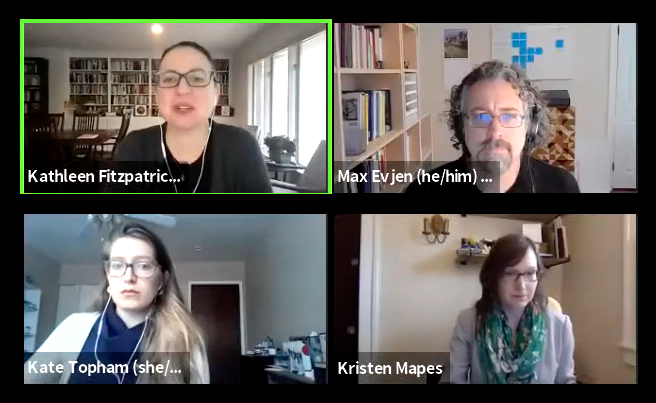
The Global Digital Humanities Symposium team (from top left clockwise): Kathleen Fitzpatrick, Max Evjen, Kate Topham, Kristen Mapes
As the world has grappled with a pandemic over the past 18 months, conferences and other gatherings have had to pivot to online spaces. The Global Digital Humanities Symposium is a great example of how the Commons can be used as both a planning tool and the space to preserve the information shared. The Commons has served the community as a resource when unexpected changes alter the ways in which we come together. We sat down with Kristen Mapes, Assistant Director of Digital Humanities at Michigan State University, and Max Evjen, Digital Humanities Coordinator, to find out how the Symposium used the Commons to navigate a virtual-first global event.
What do you do when the world shuts down and your event is in three weeks?
The 2020 Symposium was scheduled for March 26-27, just as the world was shutting down due to the COVID-19 pandemic. The planning committee had three weeks to convert the event — with attendees slated to come from multiple countries — to an online meeting, choosing Humanities Commons as the venue. Pivoting online, the team created the public group to serve as a gathering place, updated their website to explain the new format, and the Symposium took place primarily over Zoom. The website served to communicate the new technology plan, backup technologies should Zoom become overloaded, and information for presenters on strategies for converting their presentations to an online format. The Global Digital Humanities Symposium group now has 120 members, and may be used in future for calls for proposals and discussions that grow out of the symposium itself.
Why the Commons?
“Humanities Commons perfectly suits our community as it is open to all, regardless of institutional affiliation, status, or geography,” Mapes states. The Commons is attractive because, as Mapes continues, “we are bringing [participants] into (or encouraging their use of, if they already have a profile) a space that will not sell their information or surveil their work.” The Commons is academy owned and operated, and has a strong terms of service and privacy policy that is built on openness, but not at the expense of user privacy.
The Commons Offers Communication and Publishing Tools in one Package
The Global Digital Humanities Symposium was held online once again in 2021, and Humanities Commons again played an integral part. Planning was done via a private group on the Commons. Utilizing the discussion forums, the group served as a space for making visible the conversation that was taking place in the subcommittees. Mapes says that “by ensuring that discussion was included in the group threads, the entire planning committee could see what work was taking place, even within subcommittees, reducing confusion.“
Presenters had the option to email their deposits to the organizers or to deposit their materials to CORE, linking to the public group. Deposits to CORE assisted the creation of a new proceedings website, allowing organizers to quickly publish materials and giving participants and those who were unable to attend access to all the materials on a timely basis. Mapes reflects, “We are thrilled to use the Commons to host our Proceedings because it mints DOIs for all CORE contributions, making the work more readily cited and understood in academic contexts globally. Humanities Commons also allows us to create a site without a financial outlay that may not be sustainable in the future and keeps the site free from any institutional affiliation, in case the Symposium grows in different directions in the long term.”
What’s Next for the Global Digital Humanities Symposium?
This year’s symposium welcomed proposals in English, French, and Spanish along with real-time interpretation and closed-captioning. By using the Commons, organizers ensure that artifacts can be tagged with the correct language and subjects for easy searching and can be accessed worldwide. In thinking about the future for the public group, Mapes says, “we hope to see it grow in number as the Symposium grows, especially as we work to make the Proceedings site a referenced publication space for Global DH work.” Using the Commons allows organizers to preserve the institutional memory of the Symposium, and to ensure that committee members from across institutions have an equal voice in planning within their private planning space.
By utilizing the free tools within the Commons, the Global Digital Humanities Symposium was able to pivot online within weeks, hold two conferences serving a worldwide audience, and disseminate the work within weeks. In future, the groundwork laid during the pandemic will allow the Symposium to grow and continue to reach a larger and more diverse audience.
Welcome to Commons Highlights — a new series highlighting groups, sites, and organizations that make the Commons their home. We will be speaking with users who have created vibrant and thriving communities on how they did it, and the lessons they have learned.
The Composers of Color Resource Project
What do you do with the urgent desire to make societal change? How do you capture that initial spark, and turn it into sustained momentum? As Aaron Grant, a founding member of the Composers of Color Resource Project has said, “Many want to do anti-racist pedagogy in classes, but where do you start?” In May of 2020, as worldwide protests erupted in response to the murder of George Floyd at the hands of a Minneapolis police officer, a group of music theorists created a Slack channel that was committed to start answering these questions. The channel was created, in part, as a space to discuss ways of diversifying the music theory curriculum and developing anti-racist pedagogy. The channel immediately had a large influx of members as the music theory community reckoned with how to create and sustain badly needed DEI (diversity equity and inclusion) work within the discipline, but after a strong start the channel began to lose momentum. Among those who joined the Slack channel were the scholars who would start the Composers of Color project: Amy Fleming, Aaron Grant, Megan Long, Jan Miyake, and Sam Reenan.
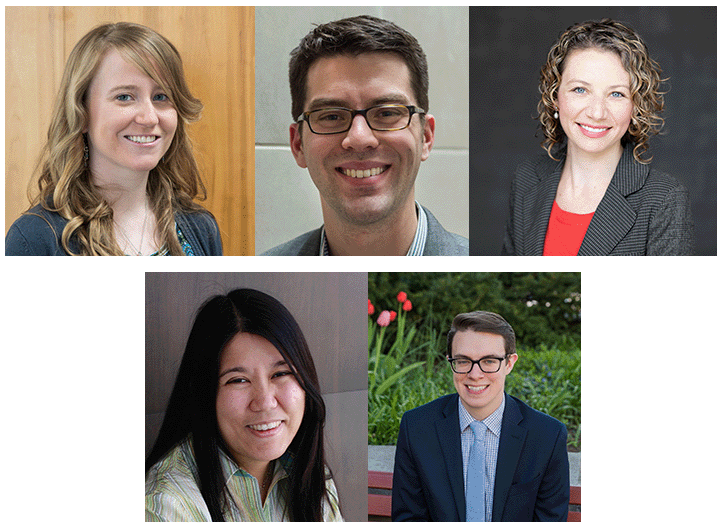
Members of the Composers of Color Resource Project. From top right: Amy Fleming, Aaron Grant, Megan Long, Jan Miyake, and Sam Reenan.
As membership and discussion slowed down within Slack, Jan Miyake suggested using Zoom to have a workshop where a subset of Slack channel members analyzed music by BIPOC composers in small groups, wrote up analytical notes, and tagged their notes with search terms that they would want when looking to diversify their teaching examples. Those who were invested in making change had something to participate in, and with this first Zoom workshop the Composers of Color Resource Project was born.
Where Do You Start?
Since July, the Composers of Color Resource Project has hosted seven analysis sessions, generated 78 pages of analytical notes, explored the work of 31 BIPOC composers, analyzed at least 80 works, created at least 30 annotated scores, built a user-friendly spreadsheet cataloging these works, and presented it all within Humanities Commons. Many users, including team members themselves, have found new research topics through the spreadsheet cataloging all of the works. Users can submit new entries through a Google Form, which are then vetted and added by the project team.
Creating the Composers of Color Resource Project wasn’t easy. To engage members the team devised a deliverable-oriented workflow to crowdsource this work, allowing users to participate without feeling solely responsible for the entirety of any one piece of it. According to Grant, “It was low effort on an individual level with crowdsourcing, but created a high impact on the discipline and on theorists’ everyday lives. Finding suitable pieces and recordings for the classroom would normally take an immense amount of time.” Crowdsourcing allowed the many people who wanted to do something to accomplish much more than they would have been able to do on their own. The group has now been able to link to existing recordings, and to identify pieces that need recording through this process.
How Humanities Commons Helped the Project Grow
Team member Sam Reenan was on a Society for Music Theory committee looking at using the Commons for society business, so he was familiar with the basic functionality of the platform. As the project team looked for a place to store the ever-expanding amount of materials, it became clear to the team that Google Drive and other file sharing services would not be adequate. Humanities Commons’ group functionality, with its ability to upload files, create collaborative documents, and group website capabilities proved to be a good fit.
“The website gave our subset of people an identity, a name, and an email,” Megan Long says. “It gave the project boundaries and became more focused. [Humanities Commons] made it easier to do stuff and organize events.”
Grant, too, sees the Humanities Commons group and site as giving the group legitimacy: “That legitimacy is necessary for things to become more than ‘backyard projects.’ There have been Google spreadsheets circulated for years. But while they are useful, not everyone feels as invested in a spreadsheet. Legitimacy makes a big difference in terms of momentum.” Grant notes that earlier projects that relied on technologies like Google Sheets didn’t create a sense of personal responsibility in those who participated. He goes on to say, “Humanities Commons is much more accessible to those who are not as tech-savvy. Having it all hosted on this website and easy to navigate is so crucial. Just like using Zoom for our meetings. Everyone now knows how to use Zoom. It’s easy to lose track of the conversation on Slack, so it’s been great to use HC and Zoom in tandem.”
While the Humanities Commons group is private (Commons users must request membership), the website is open to the public. Reenan explained, “Our field is sort of odd in that there’s a lot of people teaching music theory that aren’t music theorists (e.g. performing musicians, high school teachers). The group website is a great way of targeting people who aren’t doing this all day everyday — graduate students, adjuncts, and those who teach it as part of a larger curriculum, providing them with accessible and readily-adaptable materials.”
Publicizing the Group and Gaining Momentum
The project has over 200 members on their mailing list, and 78 participating in the Commons group. The membership has drawn those early in their career as well as senior scholars. The team has used social media (primarily Facebook and Twitter), Society of Music Theory (SMT) listservs, and Zoom events to grow their network. Through word-of-mouth even non-members are using the group’s resources. One of the ways the project team has sustained their growth and expanded the available materials is through events. Zoom sessions to work collaboratively are announced through their email list, social media, and SMT listservs.
As the collection grows, more people are exposed to the project, and the team notes that there is almost always someone in their annotated score spreadsheet. The majority of discussion has been held within Zoom, email, or Slack, however they’re currently looking at utilizing the group’s forum for further discussion. Future plans include finding ways to leverage the social media aspects of the Commons, and taking advantage of the group’s event calendar to announce events.
Plans for the Future
What’s in store for the Composers of Color Resource Project? Some of the next steps planned by the team are:
Multiplying the number of resources they have available through further crowdsourcing
Mining the resources currently available for future projects
Collecting volunteered, ready-made handouts and lesson plans that educators have created for their individual classroom and sharing them on our website
Further growing membership
Creating small groups to discuss anti-racist policies in syllabi
Creating opportunities for performers to make recordings of the pieces that have yet to be recorded
In addition to further growing the current resources, there are plans to create resources to fit into other types of curricula, crowdsourcing syllabi, and continuing to develop the raw resources available into more classroom-ready materials.
“The idea that in addition to some groundwork laid in data mining a lot of these sources, there’s a lot of room for refinement of these materials,” Grant says. “For a lot of people who may not have as much pedagogical training we could streamline that process and have a repository for handouts, lesson plans, and units.”
The Composers of Color Resource Project is a great example of like-minded people finding each other and using the power of crowdsourcing to get things done. The old adage “many hands make light work” applies here. While this type of project would be a huge and heavy lift for just a few people, by spreading it across a group diverse in age, background, and training they’ve successfully launched a growing and thriving space providing materials for those both within and outside the music theory community.
If you missed our first CORE deposit party fear not, we’ve uploaded it to YouTube. Again, a huge thanks to all of our participants!
Held on March 30, 2021, Online Communities and Transformative Justice was an opportunity to discuss the potential for online communities to engage in anti-racist praxis, transformative justice, and ethical community engagement.
Keynote: “Harnessing Good Intentions: Online Communities and Sustained Commitment to Racial Equity & Diversity,” delivered by Dr. Jan Miyake, Associate Professor of Music Theory at Oberlin College.
Lightning Talks:
“Virtual & Digital Speaker Series: Life Saving Knowledges and Critical Frameworks to Disrupt Heteronormativity,” Ruby Mendoza, Michigan State University
“Re/Building and Recovering Comics Communities Through Wikidata @ Michigan State University,” Justin Wigard, Michigan State University
“Introspective Videos as Antiracist Praxis,” Nick Sanders, Michigan State University
Welcome: Kathleen Fitzpatrick, Michigan State University
The Commons is pleased to announce the panelists for our CORE Deposit Party, Online Communities and Transformative Justice, on March 30th from 12 to 1:30pm EDT. The event will be an opportunity to discuss the potential for online communities to engage in anti-racist praxis, transformative justice, and ethical community engagement.
The event will start with three 5-7 minute lightning talks:
“Virtual & Digital Speaker Series: Life Saving Knowledges and Critical Frameworks to Disrupt Heteronormativity,” Ruby Mendoza (they/them)
This presentation explores the initiative within the MSU Writing Center, through the efforts of their Liaison to the LGBT Resource Center, to develop a digital/virtual speaker series titled “Life Saving Knowledges: Critical Frameworks to Disrupt Heteronormativity.” This speaker series utilized and centered graduate students’ intellectual knowledges and experiences to convey complex theoretical frameworks into a simplified manner for LGBTQ+ youth. In many ways, this speaker series worked in a multitude of ways, including providing students with life-saving knowledge to utilize in both academia and activism, and within their own communities outside of an educational institution. Therefore, this presentation addresses the need to understand digital community engagement as a method to empower and support emerging intersectional adults, as well as providing life saving discourses and frameworks to navigate their lives in and outside of the academy.
“Re/Building and Recovering Comics Communities Through Wikidata @ Michigan State University,” Justin Wigard (he/him)
In the wake of the COVID-19 pandemic, the Comics@MSU community sought ways to not only support existing connections within the greater comics community, but build new ones virtually by making transformative use of the MSU Libraries Comics Collection. To this end, in Fall 2020 the MSU Graphic Possibilities Research Workshop hosted a two-day virtual Wikidata Edit-a-thon, using bibliographic metadata to add missing comics publishers and authors from 1929-1956 to Wikidata. This lightning talk will discuss the planning that went into the events, along with a reporting-out of both our first event in Fall 2020 and our follow-up event to be held in Spring 2021. The event brought together 50-55 participants from MSU and across the US (even some folks from Canada & the UK) into an online community. During the event, participants worked against WikiData and Wikipedia bias, the latter being historically implicated in racial and gendered erasure other forms of bias. This lightning talk will demonstrate how, participants worked to a) connect MSU’s comics metadata to Wikidata, b) recover PoC and women comics creators’ narratives that may have been absent from Wikidata, and c) reflect their contributions in Wikidata or correcting misattributed entries therein, thereby contributing to the Digital Humanities@MSU community.
“Introspective Videos as Antiracist Praxis,” Nick Sanders (he/him)
Guided by critical antiracist (Baker-Bell; Johnson) and feminist pedagogies (Omolade; Friere), anti-deficit frameworks (Mejia et al.), and multimodal writing pedagogies (Shipka; Arola), this talk describes a reflective video assignment sequence that can support critical un/learning around whiteness and white supremacy. These video sequences story students’ identities and values and name the social forces which shape them at different points in the course. Consistent with critical race theory tenets of story and critique, these videos allow students to position themselves as embodied learners and use story as a tool of knowledge-making. This talk will also offer an assignment that invites students to draw on these reflective videos toward a larger end to track their learning goals throughout a course and to map new goals for un/learning. Ultimately, this talk will demonstrate the ways in which introspective video sequencing might support deep critical introspection consistent with antiracist and critical whiteness pedagogies, challenges performativity in written assignments, and provides maps for students to understand their learning and development in the context of a course.
Following the panel discussions there will be a keynote, “Harnessing Good Intentions: Online Communities and Sustained Commitment to Racial Equity & Diversity,” delivered by Dr. Jan Miyake, Associate Professor of Music Theory at Oberlin College. After the program the panel will be available to answer questions and meeting attendees will be encouraged to deposit work of their own into CORE. Commons Open Repository Exchange, or CORE, is a library-quality, noncommercial repository that provides members with a permanent, open access storage facility for sharing, discovering, retrieving, and archiving scholarly output. A short video on CORE can be found on the Commons YouTube channel. Syllabi, learning materials, handouts, articles, and other works on this topic or others are welcome to be deposited.