Reviewing, Editing, & Publishing: Open Access and the Public Philosophy Journal

As part of our celebrations building up to Open Access Week from October 23 – 29, we’re featuring a guest blog post authored by Shelby Brewster, the Associate Editor of the Public Philosophy Journal (PPJ). Humanities Commons and PPJ are MESH projects with generous support from Michigan State University’s College of Arts & Letters and MSU Libraries. If you’d like to learn more about PPJ, follow them on Facebook, Twitter, and Mastodon.

Like the Humanities Commons, the Public Philosophy Journal supports open access scholarly communications. The PPJ is an open access, digital-only journal that offers a forum for the curation and creation of accessible scholarship that deepens understanding of, deliberation about, and action concerning issues of public relevance. The theme of this year’s Open Access Week, “Community over Commercialization,” captures many of the ways that openness manifests in the PPJ. In contrast to many conventional publishing models, at the PPJ community is the foundation of our practices, from review to editing to publishing.

In Review: Community over Competition

At the PPJ, articles go through our Collaborative Community Review process (CCR). CCR sees the relationship between authors and reviewers as one of community rather than competition. In the collaborative review process, all parties come together as colleagues to enrich the work in question. Together with a Review Coordinator who facilitates the process, authors and reviewers engage in a constructive dialogue in which all parties are known to one another. The CCR process is completely open, recognizing that our positionality is part of our scholarship and encouraging a sense of thick collegiality for everyone involved. CCR does not serve a gatekeeping or purely evaluative function. Instead, review is rooted in mutual respect, a shared effort to advance scholarship to make a better world.

In Editing: Community over Elitism

Openness extends into our editorial policies and vision. As we explain on our website, “too often scholarly publishing engages in and reinforces exclusion rather than fostering the diversity of authors, readers, and issues in public and academic communities. Revising outdated ideas of who counts as a scholar and what counts as scholarship requires collective re-envisioning of how knowledge is developed, evaluated, and circulated through peer review and post-publication processes.” And so we maintain an open definition of expertise, recognizing that members of multiple communities that are not necessarily “academic” as such have perspectives and knowledge that benefit scholarship oriented toward the public good.

In Publishing: Community over Commercialization

All PPJ publications are open access, published in accessible formats, and available for reuse under the Creative Commons CC BY 4.0 license. We work to make our content easily accessible by communities both within and outside academia, and those that sit in between.

We also carefully consider which tools we use to create our work, as we acknowledge that these too should be aligned with our values. For publishing, we partner with Manifold, an open source publishing platform created by both publishers and scholars. Scholar-led infrastructure, like Manifold and the Humanities Commons, is an important way to value, support, and emphasize community in an ever-increasingly commercial publishing landscape.

To expand our commitment to community and support others who also wish to do so, the PPJ has been working on a new platform for values-based peer review, Pilcrow. In collaboration with Mesh Research and with the support of the Mellon Foundation, PPJ members and a development team have created an environment for a collegial review process that allows publishers and scholars to develop scholarship that aligns with their values, as well as openness and community. In the coming months, Pilcrow will be available, open source, for anyone looking to further integrate a commitment to community into their writing and publishing practice. So openness is an integral part of how the PPJ envisions community, in review, editing, publishing, and beyond. Community-led research infrastructure has the potential to not only give scholars more control over their data, but also support and facilitate innovative scholarship. Alongside our colleagues at the Commons and elsewhere, we’re committed creating community to support “scholarship as a series of collective acts toward advancing a just world.”
Publish Your Journal

On the left side, white text over a green background reads "Publish Your Journal" and "Commons Showcase." On the white side, there is a a graphic of a green computer window with a pencil on a white background.

The TL;DR

  • The Commons offers free WordPress hosting with up to 600MB of storage
  • The repository automatically assigns a DOI and the metadata is fed to aggregators (like Google Scholar) all over the world
  • The Commons community is alerted to the new journal through the activity feed and the ability to tag appropriate groups in deposits

Publishing open access benefits everyone.

Imagine a small group of scholars who see the need for an open-access journal within their discipline. They’ve started on their own with a small WordPress site and a handful of issues. They realize that hosting a website on their own can be expensive, even with a small subsidy from their department. Without a larger network to share their work, they’ve also been struggling to find and engage with new readers.

Fortunately, the Humanities Commons uses WordPress and, if the editor exports their current site, these scholars could work with the Commons team to import the content to a new WordPress site on the Commons. The first step is to create a private or hidden group with a group site. The group will allow them to communicate with one another and keep a calendar of deadlines. 

Once the site is imported, they can work to design the site and begin the process of uploading PDFs of previous articles to the CORE repository. They plan to post online-readable articles as blog posts on their website, using the link created after uploading the PDFs to the CORE repository. While they only have about 30 articles to deposit, if they had over 50, they could work with the Commons team to do a bulk upload to the repository. The deposits are automatically aggregated by Google Scholar, and fed to other aggregators around the world. 

Every time they post and make a deposit, their updates are added to the site’s activity feed. Not only can they tag their own group when they deposit an article to the repository, but they can also tag four other appropriate groups to increase the visibility of the content. With over 50,000 members, this is a lot more visibility than they’ve had previously with only a little added work.

FAQs

QuestionAnswer
My journal uses a content management system other than WordPress. Can I import the content onto the Commons?While importing may not be possible, copying and pasting content within WordPress using the block editor is relatively easy.
My journal has a dedicated domain name. Can I still use it on the Commons?All Commons sites must have the hcommons-staging.org domain in their URL. However, most registrars allow domains to be pointed to a new host. While your posts won’t be in a https://yourdomain.com/post format, you can establish a redirect to the new site.

Examples

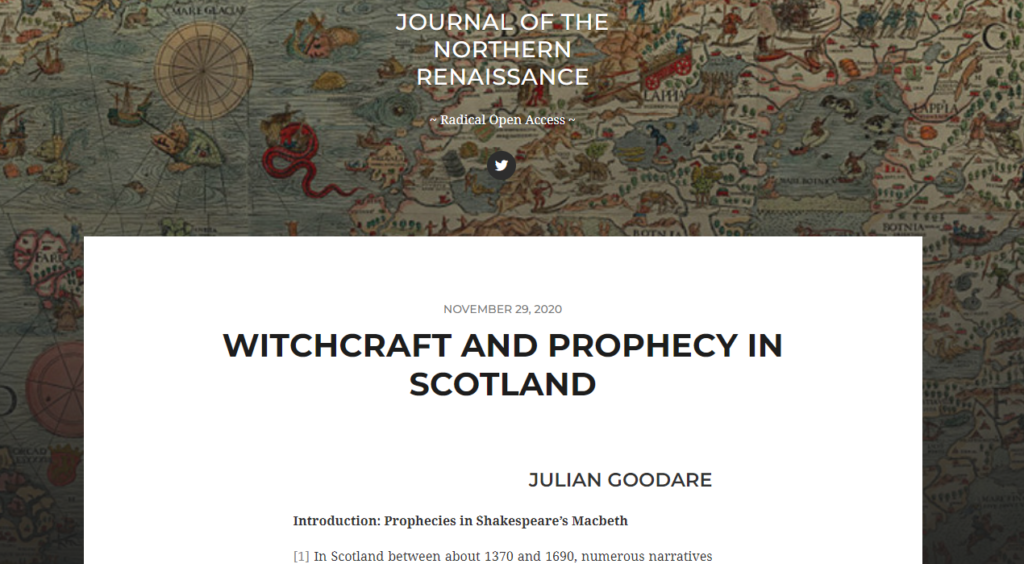
A journal from the Journal of the Northern Renaissance titled, "Witchcraft and Prophecy in Scotland."

Journal of the Northern Renaissance ↗

A journal dedicated to the study of early modern Northern European cultural practices.

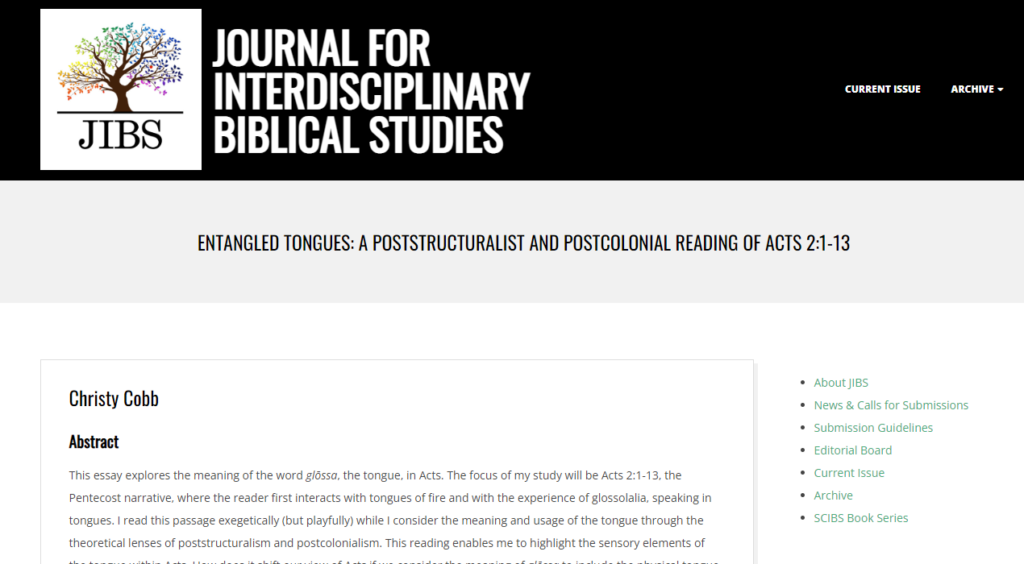
A journal from the Journal for Interdisciplinary Biblical Studies titled "Entangled Tongues: A Poststructuralist and Postcolonial reading of Acts 2:1-13"

Journal for Interdisciplinary Biblical Studies

A journal centered on interdisciplinary, social justice-oriented, feminist, queer, and innovative biblical scholarship.

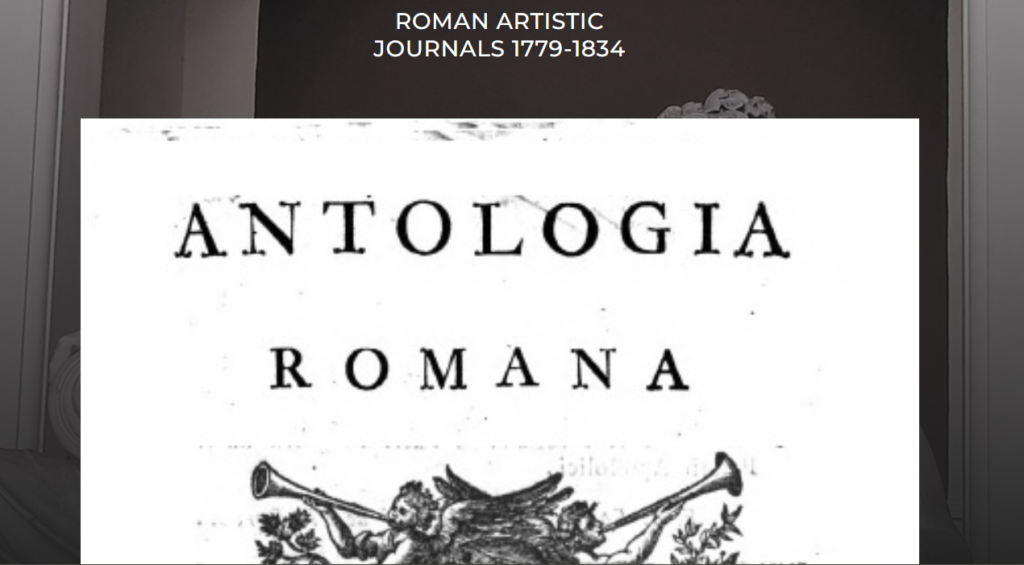
A journal from the Roman Artistic Journals (1779-1834) titled "Antologia Romana"

Roman Artistic Journals

A database that showcases late eighteenth- to early nineteenth-century Roman artistic journals.

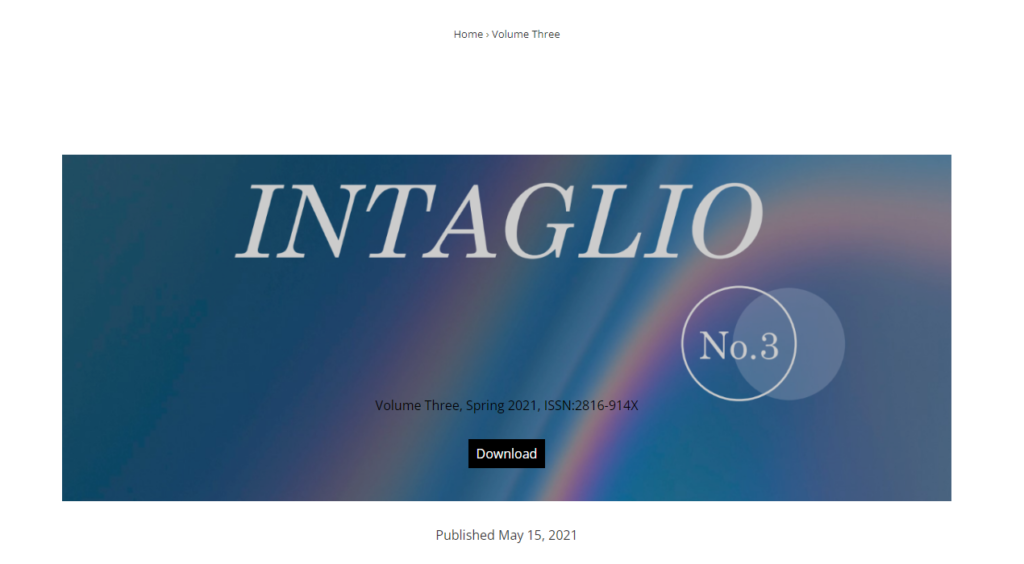
A journal from the Intagalio Journal titled "Volume Number 3"

Intaglio Journal ↗

A journal focused on work related to visual culture, seeking to bridge disciplinary and geographical divides.

Support

Support guides for sites, blogs, and WordPress

Support FAQ

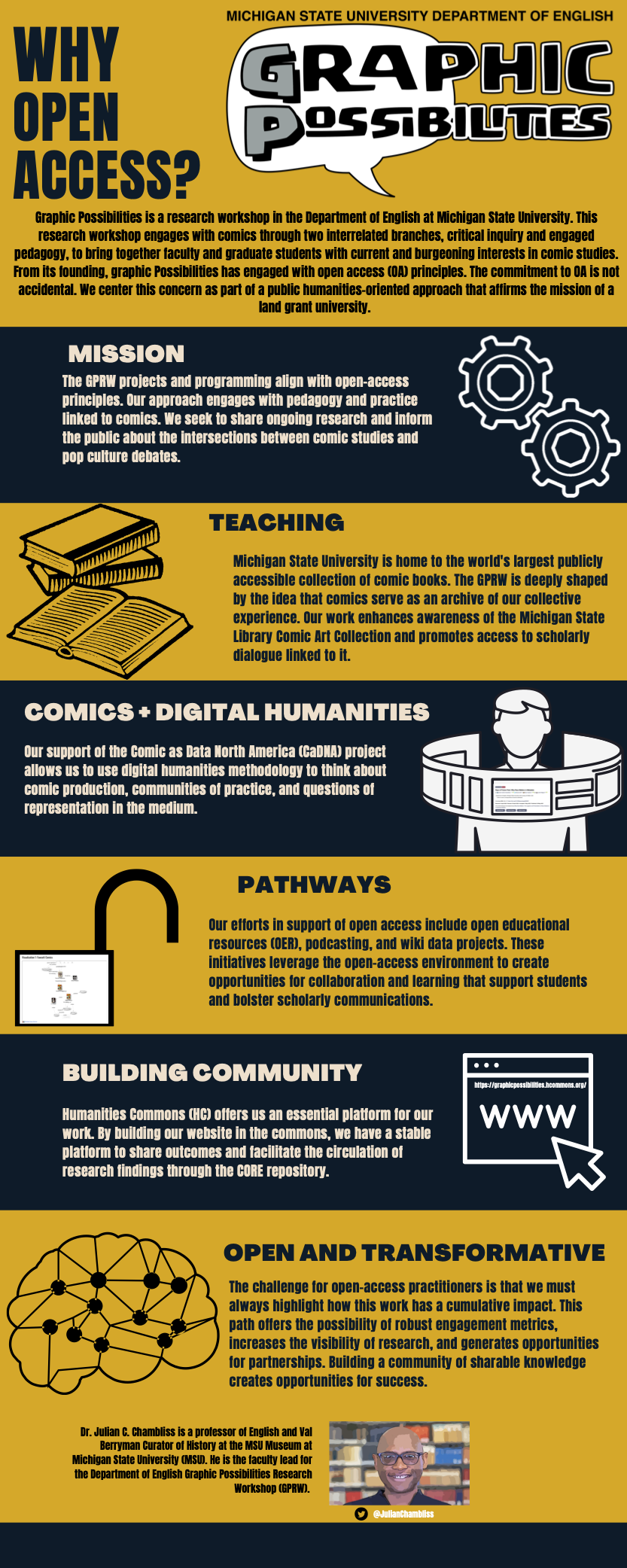
Why Open Access? An Infographic from Julian Chambliss

This week, October 24-30, is International Open Access Week and we’re celebrating by partnering with some of our friends to reflect on the theme of joy in open access!

In this infographic by Julian Chambliss—Professor of English at Michigan State University, Val Berryman Curator of History at the MSU Museum, and faculty lead for the Graphic Possibilities Research Group—shares his perspective on why open access matters.

An infographic titled "Why Open Access?" with information on the mission of the Graphic Possibilities project, connections with teaching, digital humanities,  and community building.
This infographic describes the impact of open access on Graphic Possibilities Research Group at Michigan State University. [Long description] [PDF version]